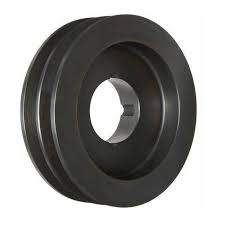
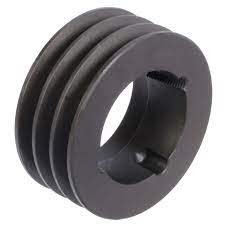
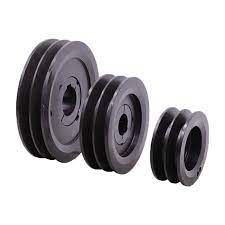
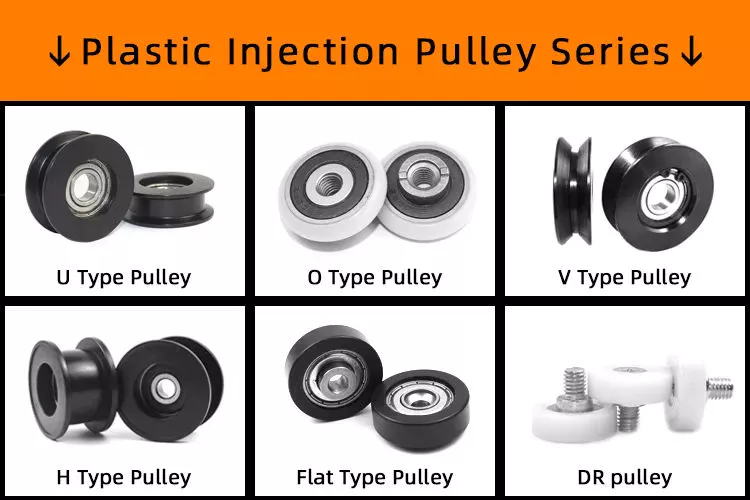
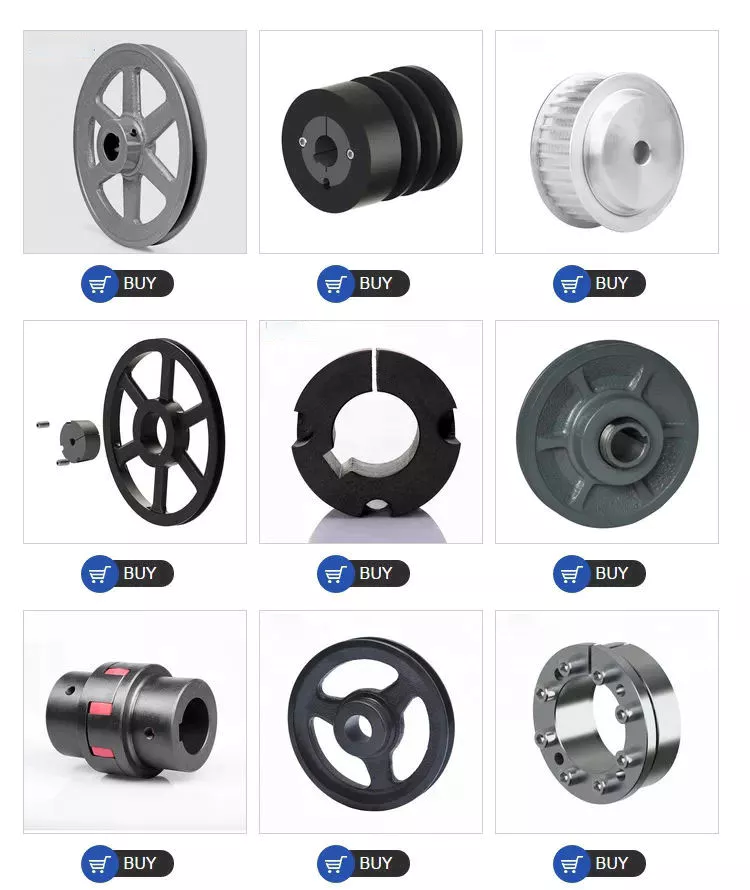
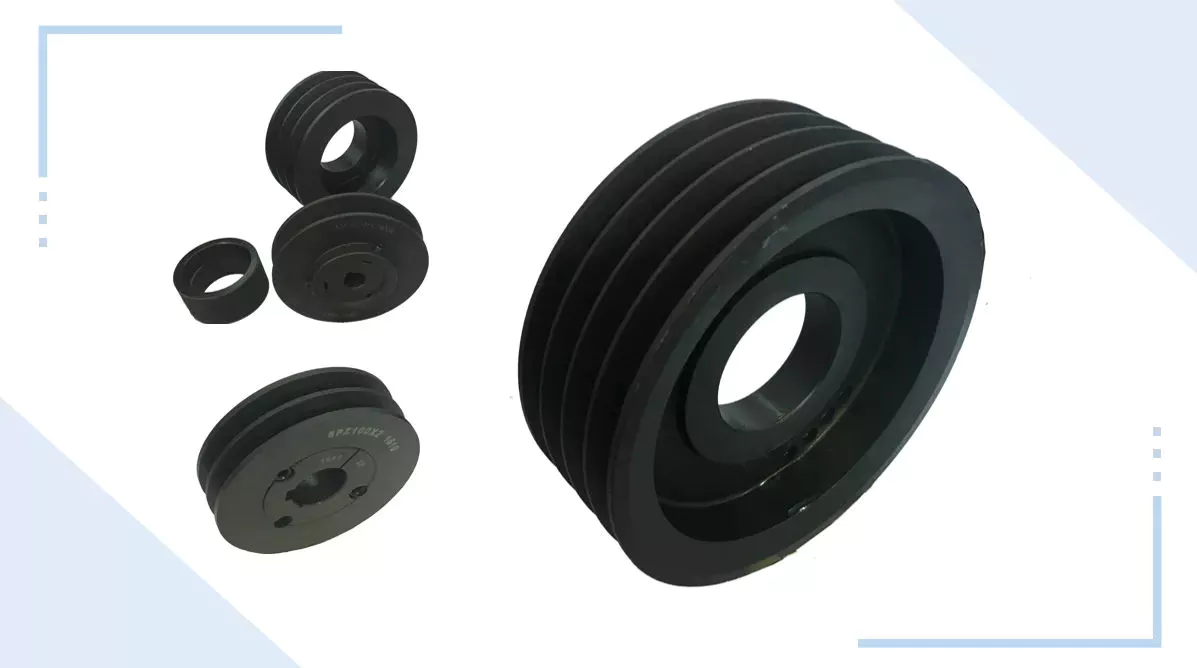
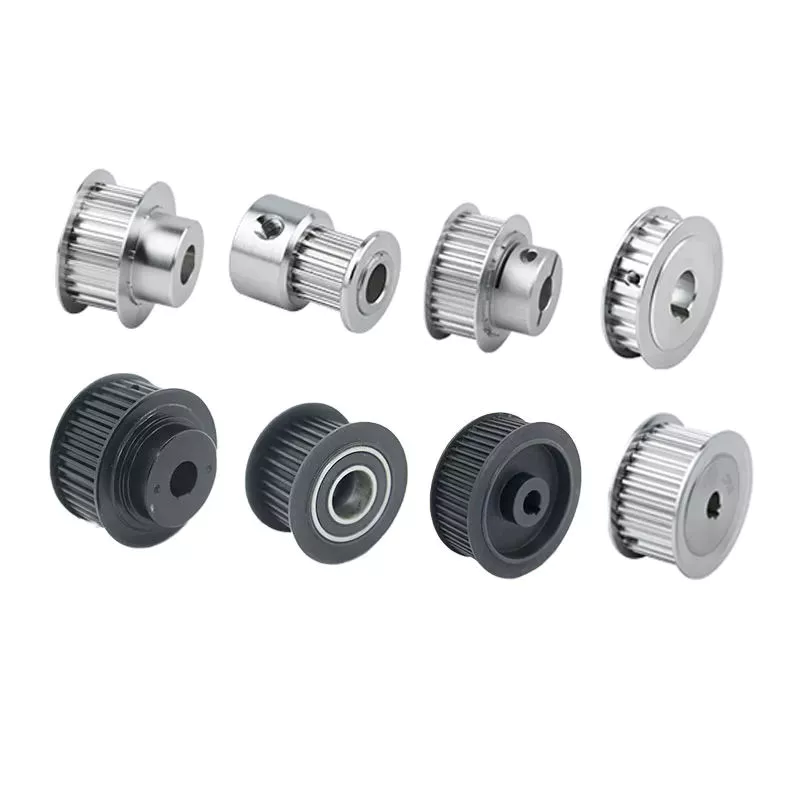
With more than 15 years’ experience, high-precision equipment and strict management system, CIMO can provide V belt pulley for you with stable quality and best service.
Cast Iron V Belt Pulley,V pulley, v belt pulley, v groove pulley, v groove belt pulley, taper lock pulley, taper lock v belt pulley, taper lock bushing pulley, taper lock pulleys / taper bore pulley, large v belt pulley, double v belt pulley, cast iron v belt pulley belt pulley, variable speed v belt pulleys, v belt pulley split pulley, cast iron v belt pulley
V belt pulley specifications:
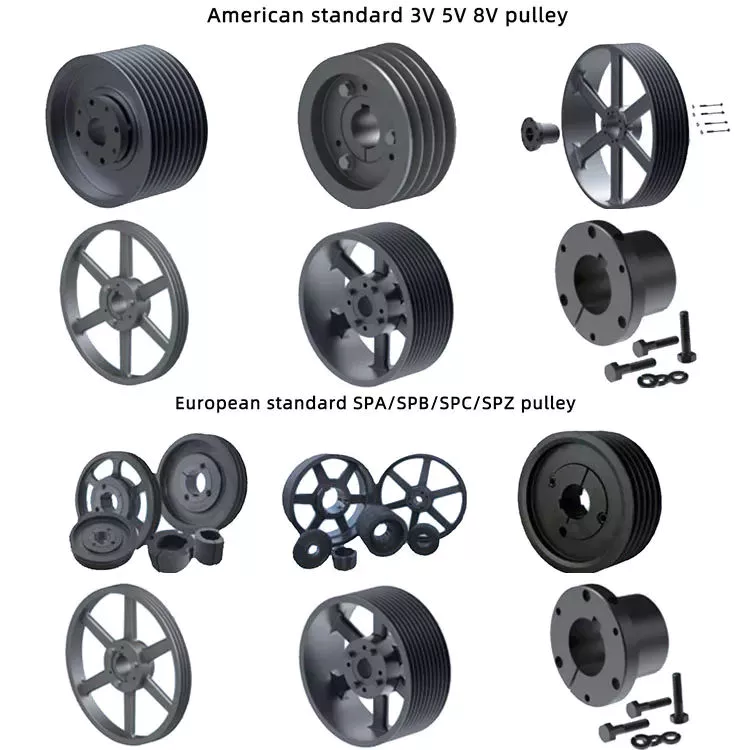
1) European standard: A) V-belt pulleys for taper bushings: SPZ, SPA, SPB, SPC; Up to 10 grooves B) Adjustable speed V-belt pulleys and variable speed pulleys C) Flat belt pulleys and conveyor belt pulleys 2) American standard: A) Sheaves for taper bushings: 3V, 5V, 8V B) Sheaves for QD bushings: 3V, 5V, 8V C) Sheaves for split taper bushings: 3V, 5V, 8V D) Sheaves for 3L, 4L or A, and 5L or B belts: AK, AKH, 2AK, 2AKH, BK, BKH, 2BK, 2BKH, 3BK E) Adjustable sheaves: Poly V-pulley, multi-pitch H, L, J, K and M 3) Bore: Pilot bore, finished bore, taper bore, bore for QD bushing 4) Surface finish: Paint, phosphating, zinc plated 5) Material: Cast iron, ductile iron, nylon, aluminum 6) Made according to drawings and/or samples, OEM inquiries welcomed
SPA56
SPB56
SPC56
SPZ56
1008
SPA63
SPB63
SPC63
SPZ63
1108
SPA67
SPB67
SPC67
SPZ67
1210
SPA71
SPB71
SPC71
SPZ71
1215
SPA75
SPB75
SPC75
SPZ75
1310
SPA80
SPB80
SPC80
SPZ80
1610
SPA85
SPB85
SPC85
SPZ85
1615
SPA90
SPB90
SPC90
SPZ90
2012
SPA95
SPB95
SPC95
SPZ95
2017
SPA100
SPB100
SPC100
SPZ100
2517
SPA106
SPB106
SPC106
SPZ106
2525
SPA112
SPB112
SPC112
SPZ112
3571
SPA118
SPB118
SPC118
SPZ118
3030
SPA125
SPB125
SPC125
SPZ125
3525
SPA132
SPB132
SPC132
SPZ132
3535
SPA140
SPB140
SPC140
SPZ140
4030
SPA150
SPB150
SPC150
SPZ150
4040
SPA160
SPB160
SPC160
SPZ160
4535
SPA170
SPB170
SPC170
SPZ170
4545
SPA180
SPB180
SPC180
SPZ180
5040
SPA190
SPB190
SPC190
SPZ190
5050
SPA200
SPB200
SPC200
SPZ200
6050
SPA212
SPB212
SPC212
SPZ212
SPA224
SPB224
SPC224
SPZ224
SPA236
SPB236
SPC236
SPZ236
SPA250
SPB250
SPC250
SPZ250
SPA265
SPB265
SPC265
SPZ265
SPA280
SPB280
SPC280
SPZ280
SPA300
SPB300
SPC300
SPZ300
SPA315
SPB315
SPC315
SPZ315
SPA335
SPB335
SPC335
SPZ335
SPA355
SPB355
SPC355
SPZ355
SPA400
SPB400
SPC400
SPZ400
SPA450
SPB450
SPC450
SPZ450
SPA500
SPB500
SPC500
SPZ500
SPA560
SPB560
SPC560
SPZ560
SPA630
SPB630
SPC630
SPZ630
SPA710
SPB710
SPC710
SPZ710
SPA800
SPB800
SPC800
SPZ800
SPA900
SPB900
SPC900
SPZ900
SPA1000
SPB1000
SPC1000
SPZ1000
Detailed Photos
SPC560-10-5050
SPB1000-4-4040
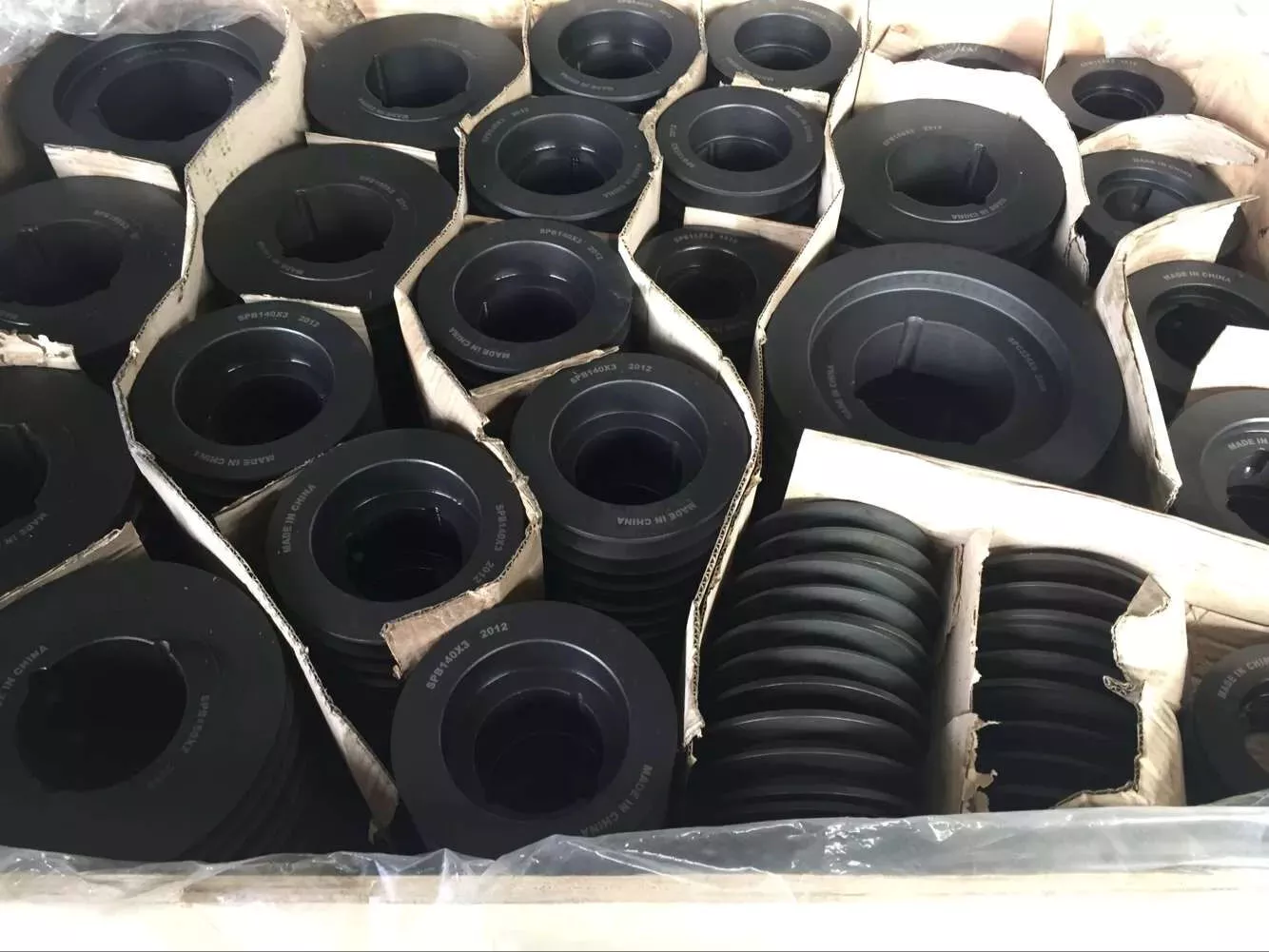
Large stock in warehouse
Workshop
Packaging & Shipping
Export wooden box
FAQ
Q1: Are you trading company or manufacturer ?
A: We are factory.
Q2: How long is your delivery time and shipment? 1.Sample Lead-times: 10-20 days 2.Production Lead-times: 30-45 days after order confirmed.
Q3: What is your advantages? 1. The most competitive price and good quality. 2. Perfect technical engineers give you the best support. 3. OEM is available.
Certification:
ISO
Pulley Sizes:
Type A
Manufacturing Process:
Casting
Material:
Iron
Surface Treatment:
Phosphated
Application:
Chemical Industry, Grain Transport, Mining Transport, Power Plant
Customization:
Available
|
Customized Request
Are there different types of spa pulleys, and how do they vary in spa applications?
Yes, there are different types of spa pulleys available, and they can vary in terms of design, materials, and specific applications within a spa system. Here’s a detailed explanation of the various types of spa pulleys and their variations in spa applications:
1. V-Belt Pulleys:
V-belt pulleys are one of the most common types of pulleys used in spa applications. They feature a V-shaped groove that matches the cross-section of V-belts, which are commonly used power transmission belts. V-belt pulleys provide reliable power transmission, high torque capacity, and are suitable for moderate to heavy-duty applications. They are often used in spa systems to transfer power from the motor to various components such as pumps, blowers, or jets.
2. Flat Belt Pulleys:
Flat belt pulleys, as the name suggests, have a flat surface for belt engagement. They are typically used with flat belts made of materials such as rubber or fabric. Flat belt pulleys are suitable for applications requiring moderate power transmission and are commonly used in spa systems for driving components like pumps or fans.
3. Timing Belt Pulleys:
Timing belt pulleys are designed to work specifically with timing belts, which have teeth on the inner surface. The teeth on the belt mesh with corresponding grooves on the pulley, enabling precise and synchronous power transmission. Timing belt pulleys are commonly used in spa applications where accurate timing and synchronization of components are required, such as in spa control systems or automated functions.
4. Idler Pulleys:
Idler pulleys are used to redirect or guide belts within a spa system. They do not transmit power but help maintain proper belt tension and alignment. Idler pulleys can be used in conjunction with other types of pulleys to ensure smooth operation and prevent belt slippage or excessive wear. They are commonly found in spa systems where multiple pulleys and belts are used, such as in complex pump or motor configurations.
5. Materials:
Spa pulleys can be made from various materials, and the choice of material depends on factors such as durability, resistance to corrosion, and compatibility with the spa environment. Common materials used for spa pulleys include stainless steel, aluminum, brass, or various types of plastics or polymers. Stainless steel and aluminum pulleys are often preferred for their corrosion resistance, while plastics or polymers may be used for their lightweight properties or chemical resistance.
6. Size and Configuration:
Spa pulleys come in different sizes and configurations to accommodate specific spa applications. The size of the pulley, including its diameter and width, is determined based on factors such as the power requirements, belt size, and desired speed ratio. Pulleys may have different numbers of grooves or teeth to match the number of belts or the desired timing of the system. The specific configuration and size of the pulleys are chosen to ensure proper power transmission, belt engagement, and compatibility with the overall spa system.
In summary, there are different types of spa pulleys, including V-belt pulleys, flat belt pulleys, timing belt pulleys, and idler pulleys. They can vary in terms of design, materials used, and specific applications within a spa system. The choice of pulley type, material, and size depends on factors such as the power requirements, belt type, desired speed ratio, and compatibility with the spa environment. Proper selection and use of spa pulleys are crucial for efficient power transmission and reliable operation of various components within the spa system.
How do spa pulleys impact the overall performance and water quality in a spa?
Spa pulleys have a significant impact on the overall performance and water quality in a spa. Here’s a detailed explanation of how spa pulleys influence these aspects:
1. Water Circulation:
Spa pulleys play a critical role in facilitating water circulation within the spa system. The pulleys are connected to the pump impeller, which generates the necessary water flow. Efficient power transmission from the motor to the pump impeller ensures adequate water circulation throughout the spa. Proper water circulation helps maintain even water temperature, ensure uniform distribution of chemicals, and prevent the formation of stagnant areas where contaminants can accumulate.
2. Jet Performance:
The performance of spa jets, which provide hydrotherapy and massaging effects, is influenced by the pulleys. By controlling the speed and torque output of the pump impeller through the pulleys, the intensity and pressure of the jets can be adjusted. Properly sized and configured pulleys enable optimal jet performance, allowing users to customize the water pressure and flow rate to their preferences. This enhances the overall spa experience and ensures the effectiveness of hydrotherapy treatments.
3. Air Delivery:
In spas equipped with air blowers or air injectors, spa pulleys also impact the delivery of air. Air blowers or injectors are often driven by the motor through pulleys and belts or cables. The pulleys control the speed and power transmission, influencing the amount and intensity of air delivered to the spa. By adjusting the pulley size or ratio, the air delivery can be modified, affecting the aeration and bubbling effects in the spa. This contributes to the overall ambiance and relaxation experience for spa users.
4. Energy Efficiency:
Well-designed and properly maintained spa pulleys contribute to energy efficiency in the spa system. Efficient power transmission from the motor to the pump or other driven components minimizes power losses, reducing energy consumption. By ensuring the pulleys are correctly sized, aligned, and tensioned, unnecessary friction and wear can be minimized, resulting in smoother operation and improved energy efficiency. This not only reduces operating costs but also supports sustainable and eco-friendly spa practices.
5. Water Filtration:
Proper water filtration is crucial for maintaining water quality in a spa, and spa pulleys indirectly impact this process. The pump, driven by the pulleys, circulates water through the filtration system, removing debris, particles, and contaminants. Effective power transmission ensures sufficient water flow through the filter, optimizing its filtration capacity. Clean and properly functioning pulleys contribute to uninterrupted water filtration, preventing clogs or reduced filtration efficiency. This helps in maintaining clear and healthy spa water.
6. Overall System Reliability:
Reliable spa pulleys are essential for the overall performance and longevity of the spa system. Well-maintained pulleys minimize the risk of belt or cable slippage, misalignment, or premature wear. This enhances the reliability and durability of the pulley system, reducing the likelihood of breakdowns or interruptions in spa operation. A reliable pulley system ensures consistent performance, allowing spa owners to enjoy their spa with confidence.
In summary, spa pulleys have a significant impact on the overall performance and water quality in a spa. They influence water circulation, jet performance, air delivery, energy efficiency, water filtration, and the overall reliability of the spa system. By ensuring proper sizing, alignment, tensioning, and maintenance of the pulleys, spa owners can optimize the performance, enhance the spa experience, and promote clean and healthy spa water.
What are the benefits of using spa pulleys for various components in a spa?
Using spa pulleys for various components in a spa offers several benefits. Here’s a detailed explanation of the advantages of using spa pulleys:
1. Efficient Power Transfer:
Spa pulleys provide an efficient means of power transfer from the motor or drive source to various components within the spa. By utilizing pulleys, rotational power can be transmitted smoothly and effectively, ensuring optimal performance of the driven components. This efficiency helps in achieving reliable operation and maximizing the functionality of the spa system.
2. Adjustable Speed and Torque:
Spa pulleys, when combined with different pulley ratios or sizes, allow for speed and torque adjustments in the driven components. By changing the pulley configuration, the rotational speed or torque output can be modified to meet specific requirements. This flexibility enables customization of the spa system, accommodating different water flow rates, jet intensities, or other operational preferences.
3. Noise Reduction:
Spa pulleys, particularly when used with belts or cables that offer good shock absorption properties, help in reducing noise during operation. Vibration and noise produced by the motor or drive source can be dampened by the use of pulleys, resulting in a quieter spa experience. This is especially important for those seeking a tranquil and relaxing environment while using the spa.
4. Enhanced Component Durability:
By employing spa pulleys, the load on the driven components, such as pump impellers or blower fans, is distributed more evenly. This helps to reduce stress and wear on individual components, leading to enhanced durability and longevity. The use of pulleys can help protect critical components from excessive strain, ensuring their reliable performance over time.
5. Reliable Water Circulation and Jet Operation:
Spa pulleys play a crucial role in facilitating water circulation and jet operation within the spa system. By transferring rotational power to the pump impeller, the pulleys ensure efficient water movement and proper jet performance. This reliable circulation and jet operation contribute to the overall effectiveness of the spa’s therapeutic effects, providing a satisfying and enjoyable experience for users.
6. Easy Maintenance and Replacement:
Spa pulleys are generally designed to be easily accessible and serviceable. This makes maintenance tasks, such as belt adjustments or replacements, more convenient. When a belt or pulley needs to be replaced, it can typically be done without requiring extensive disassembly of the spa system, saving time and effort.
Overall, the use of spa pulleys offers benefits such as efficient power transfer, adjustable speed and torque, noise reduction, enhanced component durability, reliable water circulation, and easy maintenance. These advantages contribute to the smooth operation, performance, and longevity of the various components within a spa system, ensuring a satisfying and long-lasting spa experience for users.
Our products main includes tracking shoes, flanges in engineering machines and steering knuckle in auto parts. Our business scope includes automobile, motorcycle and accessories, industrial equipment and components, manufacturing and processing machinery, metallurgical minerals and energy, hardware tools, transportation ect.we could manufacture as your demand. Click this link for more products: product-list-1.html
Our Advantages
Manufacturing capability covers the whole production process of forged parts, from mold design and manufacturing, forging, secondary processing, heat treatment, surface treatment to finishing, to provide customers with ready to use products and services.
Company Profile
ISO16949 Quality Management System Certification Factory.
We use advanced computer and technology (CAD) to design in manufacturing and mold manufacturing.
Our 8000 ton JTLY hydraulic forging machine, with a cold impact force of 1600 tons, is a super large forging machine in China. Its main products are large axial precision forging and 100kg to 300kg, with an annual output of 30000 pieces.
Our 2500 ton electric forging production line mainly produces 15kg to 30kg precision forging parts, with an annual output of more than 50000 pieces.
Our company has a variety of processing equipment, can make their own molds and processing.
Our company is equipped with a full set of heat treatment lines to ensure that your product quality is within our control.
Quality control: Strictly enforce the spirit of quality supreme excellence; fully implement ISO / 9001 quality management system; carry out incoming inspection of raw materials, production process control and product quality inspection physical and chemical laboratory:It can realize tensile impact test, chemical composition test, metallographic structure, hardness and other tests at normal and low temperatures.
Certifications
Cooperative Partner
Exhibitions&Customers
Stock&Packing
FAQ
1:Are you a genuine manufacturer? Yes, all products showed in our website are produced in our certified factory; We are also a company registered by China Customs with the right to export and import.
2: I want to keep our design in confidence; can we CZPT NDA? Sure, to protect customers’ profit is our obligatory responsibility, signed NDA would be valid to both of us..
3:What should I offer to get your quotation? Please offer us your detailed information for the product, such as drawings with 2D/3D by software Pro/E, Auto CAD, SolidWorks, UG etc; as well as materials, surface treatment, quantity, package. Any special requirements should be highlighted especially for tolerance.
4:How long is the manufacturing lead time? Mass Production:30-45 working days after sample approval by yours.The lead time is the general production period without the transportation time. We could make some special production arrangement effectively if customer has urgent need.
5:How long does it take to ship goods from China by sea? It takes about 5 weeks to European ports plus 1 week customs clearance, so you can get the container within 6 to 7 weeks.It takes about 2 weeks to east coast and 3 weeks to west coast US ports.All sea goods are shipped from HangZhou Port.
6:How long does it take to ship goods from China by air? It takes about 7 days to all major destinations.
7:What are the payment terms? Payment terms are negotiable and will improve for long term customers.During the initial stages, we request 50% of tooling fee in advance with the balance payable on acceptance of samples.Production orders can be negotiable.We prefer 30% deposit and the balance by T/T before sails.But sometimes T/T15 days after sails would also acceptable.
8:New product development process Got tooling order and sample order with 50% deposit—Hold a meeting with the relation dept.To ensure the developing schedule—Design mould, fixture and gauge and making them in our factory—mould.fixture and gauge making—producing samples—approved from customer-purchasing material-forging-heat treatment-shot blasting-machining-Inspection-package—delievery.
9:How to handle the complains? –If happen any complaints after delivery,please just show us photos and detail compliants points, we will check with the production department and QC department Immediately and give you best solving solution which agreed by both of us.
Jackie Jiang is always at your service !
Certification:
IATF16949
Tons of Our Manufaturing Machine:
8000tons
Do You Have ISO Certification:
Sure ISO9001:2015
The Weight Range of Our Products:
0.5kg to 300kg
The Material We Use Usually:
45#, 35#, 40cr, 42CrMo, 30crmnsia
Could We Do OEM:
of Course Yes
Samples:
US$ 200/Piece 1 Piece(Min.Order)
|
Request Sample
Customization:
Available
|
Customized Request
Overview of Different Types of Pulleys
A pulley is a wheel mounted on a shaft or shaft. Its purpose is to facilitate the movement or change of direction of the cable or taut rope, and to transmit power between the cable and the shaft. Pulleys are typically used for lifting, winding or forklift applications. If you are building your own pulley system, the following design and installation considerations should be followed. This article will give you an overview of the different types of pulleys.
Pulley System Mechanics
There are many different ways to utilize the mechanism of the pulley system. The most basic pulley system consists of a fixed wheel and a support frame. Both components are connected by ropes or cables used to support the load. A pulley system is effective when the force required to lift the load is less than the weight of the object being lifted. One way to use a pulley system is to suspend a block with a mass of 0.80 kg on a fixed pulley. Then another person can hang a bucket weighing up to 40kg. The weight of the bucket is transferred to the fixed pulley. The rope is attached to the pulley by a loop or sling. The rope will spin and pull on the barrel or block. The pulley system is also an important tool for lifting heavy objects. Pulleys are often used in construction equipment to make lifting heavy objects easier. Gun tackles, yard tackles, and stationary tackle systems are common examples of these devices. They use the mechanical advantage of the design to guide the force that lifts the object. If you want to learn more about pulley systems, visit Vedantu. This website will provide you with a full description of the mechanism and its application.
Types of pulleys
Many different types of pulleys are used to lift heavy objects. They change the direction of the force and are an integral part of the cable system. Therefore, pulleys can move large and heavy objects more easily. However, before buying a pulley, you should have an idea of the benefits it brings. Below are some of the most common uses for pulleys. Conical Pulley: Consists of several small conical pulleys connected to each other. The larger base of one pulley is used to guide the force. Round pulleys are used in the same way as step pulleys. They are widely used in industry and can be purchased at any hardware store. Pulleys are a huge investment, and the benefits they provide far outweigh the cost. Movable Pulls: These are similar to their names, but work by allowing objects to move with the pull. Their movable parts are attached to the object to be lifted. They are also ideal for lifting heavy loads and can be found in utility elevators and construction cranes. They are also used in many other industries. They can also be made of wood, plastic or metal. The type of pulley you use depends on its intended use.
Mechanical Advantages of Pulley Systems
A pulley system is a simple machine that reduces the effort required to lift heavy loads. This mechanical advantage is proportional to the number of loops. For example, if you have a single rope loop, you must apply equal force to lift the weight. When you add another rope loop, you can lift heavier weights just by applying the same force. Therefore, a pulley system is an excellent way to use gravity to your advantage. Mechanical advantage is a measure of the effectiveness of a pulley system. This ratio of force to work is called the mechanical advantage. In other words, if the rope system has a large mechanical advantage, it means that it requires less force to lift heavier loads. This advantage is usually measured in kilograms and is the same for all pulley systems. In general, the greater the mechanical advantage, the less effort is required to lift the load. The mechanical advantage of a pulley system is that a single movable pulley requires half the force to lift an object than a single fixed pulley. Assuming frictionless bearings, the MA of a single pulley system is 2, similar to the MA of a single lever. A single pulley travels twice as much as it takes to move heavy objects manually.
Considerations when designing and installing a pulley system
The capacity of the pulley depends on the type and diameter of the cable. Besides its diameter, its sheath should also support it well. The basic function of the pulley is also important. However, most people tend to ignore the pulley selection process, resulting in ineffective load-pull capabilities. To avoid such problems, different parameters must be carefully considered during design and installation. During the design and installation of the pulley system, the ratio of the cable diameter to the largest pulley diameter must be considered. Those who work in the industrial sector will have an idea of this ratio. The greater the D:d ratio, the greater the capacity of the cable to withstand the load. The best way to ensure secure design is to take the right information and use it to design a system that is both robust and secure. When designing a pulley system, it is important to remember that the pulley needs to have enough power to operate safely. In addition to horsepower, the belt should have sufficient elongation to absorb shock loads. If the elongation of the belt is very small, it is very likely that the teeth will be sheared or broken, causing serious damage to the system. Extensive belt sag should be compensated for by offsetting the driven pulley. Finally, the frame supporting the pulley should be rigid. Otherwise, the non-rigid frame will cause center distance and tooth skipping changes.
Add more pulleys to the system
Adding more pulleys to the spool might have some effect. The friction between the rope and the pulley increases with the number of pulleys, which in practice limits the number of spools. The best solution is to combine the pulleys into one housing. If the load is small enough, adding a few pulleys probably won’t make a difference. Using multiple pulleys allows a single load to be lifted with half the force required. The longer the rope, the greater the mechanical advantage. In fact, a spool can withstand a load of 100 N. Additionally, adding more pulleys quadrupled the mechanical advantage. In this case, a single 100 N load would require a force of 25 Newtons. When the rope is used, it stretches as the weight of the object increases. This will make the rope longer, increasing its length and increasing the distance over which the load can be lifted. Eventually, the rope will break and the lifted object will fall. Then you will have to buy a new rope. It may seem like an expensive proposition, but it pays off in the long run.
cast iron pulley
Cast iron pulleys are the most popular choice among industrial users. They are made of solid cast iron and usually cost very little. Their rims are held in place by a mesh that extends from a central boss. They also have spokes and arms that hold them in place. These pulleys are ideal for a variety of applications including fan belts, compressors and conveyors. V-groove drive pulleys are ideal for general purpose pulleys. It has an inner diameter of one inch and is commonly used in feeders and ventilation curtain systems. Its steel straps prevent rust and ensure it meets or exceeds industry standards. 3-1/2″ cast iron pulleys are also available. In addition to the V-groove drive pulley, there are similar pulleys for power transmission. The V-groove drive pulley is powder coated for added durability. The cross section of the arm is elliptical, with the long axis twice as long as the short axis. The radius of the arm is equal to the diameter of the pulley. The thickness of the arm is a key factor to consider when purchasing a pulley. If you’re not sure which material you need, you can always consider wooden or steel pulleys. They are lighter and have a higher coefficient of friction than metal pulleys.
timing pulley
Plastic timing pulleys have many advantages over steel timing pulleys. On the one hand, they are lightweight and corrosion resistant, making them ideal for applications that do not require high torque and tensile strength. Another benefit is their resistance to high temperatures. Plastic timing pulleys are ideal for applications involving flammable gases, solvents or particles. They can last for many years. For more information on the different types of plastic timing pulleys. Vertical shaft drives require flanged timing pulleys. For large span drives, at least one of these pulleys must be flanged. The flange provides a secure connection to the shaft and prevents ratcheting of the timing belt. Finally, HTD timing belt teeth prevent timing belt ratcheting. These teeth need a large enough space to be seated. However, they can also cause a backlash. These pulleys are not suitable for applications where positional accuracy is critical. Timing belt systems are designed to avoid such problems. The drive shaft and the driven shaft are aligned with each other. The pulleys are located on different planes and are connected by pitch lines. The pitch line of the timing pulley coincides with the pitch line of the belt. These pulleys are also easier to implement and maintain. It is better to use a synchronous system because the resulting gear system emits less noise than other systems.
Variety: Sea, Air, Express Model: SUPRA (_A8_) Motor: 3. i Bi-Turbo (JZA80_) Year: 1993-2002 OE NO.: 13505-67040 Vehicle Fitment: Toyota Reference NO.: 0187-GRJ150, CZPT hub wheel motor 4.5inch 24V 200W 300RPM 150kg load IP54 1571 PPR encoder push wheel dc electrical motor for robot engines PB-1308 Motor Code: 1KD/2KD Dimension: oem size Guarantee: 1year Car Product: In shape FOR 1KD /2 KD WARRATY: 1YEAR OEM NO: 13505-67040 MOQ: two hundred Packaging Details: outside packing is neutral carton,for single timing belt parts kits can use coloration box,nylon bag, 8mm 10mm Soar Ring Open up Metallic Chain for Jewellery Making Accent Provides also acknowledge custom-made Port: NingBo
Warmly Remind: on the web-photograph nd on the web-price only for pricey you reference,not the final price tag ,pls inquiry the salesman according to your specific requirements (packing , Dropshpping New Arrival 18mm Iced Out Cuban Link Chain Gold Plated Brass AAAAA CZ CZPT Luxurious Miami Cuban Necklace For Males QTY,quality need and quantity)
Part No.
Suit for automobile model
Motor product
Name
Warranty
MOQ
13505-67040
TOYOTA HILUX FORTUNER
1KD/2KD
TENSIONER PULLEY
1year/50000km
100
Loafer PULLEY
Types of pulleys and their advantages and disadvantages
There are several types of pulleys. Learn the basic equations of the pulley system. Then learn about the different uses for pulleys. The disadvantages of using pulleys will be covered. Knowing these, you can buy the pulley that suits your needs. Here are some of the best pulley types and their pros and cons.
Basic equations of pulley systems
A pulley system is a mechanism that allows two blocks of a certain mass to be connected by a taut rope. The acceleration of each block is the same in magnitude and direction. The external force acting on each block is the weight of the block (10g) and the tension in the string. The tension between the two blocks is the total tension and the force acting on the pulley is the weight of the two blocks. This simple mechanism uses two simple equations to explain how the system works. First, the mass of the weight on both sides of the pulley must be the same. When the weight is forced to move, the rope tightens and the second pulley descends. The weight is also attached to the second pulley and must be the same distance as the first pulley. This will result in a speed ratio of 2 times the distance covered by the first pulley. Second, we have to calculate the force required to lift the object. The lower mass is supported by a wire configuration passing through all pulleys, while the uppermost pulley is used to apply the force. The lower block is used to support the weight. The applied force needs to travel a distance nx to move the weight. This distance, called MA, can be written as: Once we have gathered the necessary information, we can apply the calculations to the pulley system. We can also use the Mechanical Advantage Calculator to calculate the force on the anchor. To do this, we must apply a force to the load as well as to the pulley itself. Using this equation, we can calculate the force required by the load to lift the load.
Types of pulleys
There are three basic types of pulleys: movable, fixed and compound. Both types of pulleys translate the force applied to them. The ideal mechanical advantage of pulleys is two. This is because a single movable pulley only doubles the force, whereas a compound pulley doubles or triples the force. This type of pulley is often used with other types of pulleys. Movable pulls move with the weight of the load, and the force pulling them increases on the lift side. They are often found in utility elevators and construction cranes. These systems are very simple, inexpensive and quiet to use. The force required to lift the object depends on the mechanical advantage of the system. The two most common types of pulleys are listed below. Let’s take a closer look at each one. V-shaped pulleys are used in vehicles and electric motors. These pulleys require a “V” belt to function properly. Some have multiple “V” grooves to avoid slipping. They are used in heavy duty applications to reduce the risk of power slip. These pulleys also have more than one “V” groove. V-belt pulleys are commonly used in vehicles and electric motors. Composite pulleys are made from more than one type of cable or rope wrapped around the wheel. They can be fixed or hinged and are usually made of stainless steel or bronze. Composite pulleys have multiple layers and can be a single unit or many different components. There are three main types of pulleys: fixed pulleys and composite pulleys. These are the most common types. Almost every type of pulley is used for some type of application. Fixed pulleys have one advantage over movable pulleys: they change direction as the weight of the load increases. They are typically used in heavy construction equipment. Gun tackles, patio tackles, and stationary tackles are examples of equipment that use a pulley mechanism. These devices are very common and can be found on most modern construction sites. They provide great convenience for lifting large loads.
application
What are the applications of pulleys? Simply put, a pulley is a mechanical device that transforms a difficult task into an easier one. It consists of ropes and pulleys. It is usually used to lift objects. Usually, people wrap a rope around a pulley and pull up to lift the object. One disadvantage of using pulleys is that they require the same force as lifting the object directly. One of the most popular applications of pulleys is lifting heavy objects. They help people pull up heavy objects and blocks. The system can also be used in seeders, lifts, grinders, etc. Other applications include raising flags, loading cargo, pulling curtains and rock or mountain climbing. Students can learn about the various uses of pulleys and the physics behind them. Pulleys can be made of many different materials, depending on the application. Some are movable, which means they move with the object they are used to lift. This pulley system can be made of nylon, wire rope or fiber material. The best part about these systems is that they are easy to install and maintain. For a better grasp, use the guide or video tutorial to learn more about the pulley system and how it works. Tapered pulleys are common in paper mills. They are high-quality pulleys that transmit power to connected parts. They can be dynamic or static and have different balances. Because pulley systems are highly customized, most industrial applications require systems designed specifically for specific applications. In this way, the system is safe, simple and inexpensive. The benefits of this design are endless. The most common use of pulleys is for motor drives. They are used to minimize noise by applying force to the shaft to reduce the workload. They are also less expensive than gears and do not require lubrication. Furthermore, they can change the direction of the applied force. They are also less expensive than gears and are often used with other components. A screw is a cylindrical member with helical ribs used to connect something.
shortcoming
Although the pulley system makes it easier to move heavy objects, it still has some drawbacks. When using a pulley system, you must remember that the force required to lift the weight increases with the number of cycles. In addition, the distance between the puller and the heavy object increases, which may lead to accidents. Also, moving heavy objects can be tricky if the rope slips. Pulley systems are not very expensive and can be easily assembled. However, it does require a lot of space. First, it is not efficient. Besides being inefficient, pulleys produce different forces at different speeds. Fixed pulleys use more force than the load, while movable pulleys move with the load. A movable pulley requires less force than a fixed pulley, but the combined system travels a long distance. Therefore, this method is not as efficient as the fixed method. Pulleys are not only used in industrial processes. You can see them in various places in your daily life. For example, large construction cranes use pulleys to lift heavy loads. Even flagpoles, blinds, clotheslines, ziplines, motors and climbing equipment use pulleys. Still, despite their advantages, the disadvantages are not too serious. Another disadvantage of the pulley is its wear and tear. While a pulley’s housing is theoretically infinite, its bearings and locking components typically wear out over time. To overcome this problem, a new bearing and locking assembly can be installed. No need to replace the housing and shaft, the entire assembly can be re-bonded and painted to replicate the original look. Alternatively, the pulley can be replaced with a new housing and shaft. Using pulleys can also reduce the advantage of pulleys. On the other hand, interception and tackle is a system in which two pulleys are connected to each other using ropes. Unlike pulleys, pulley pulley systems can be adjusted in the direction of travel and can move heavy loads up to four times their force when used in hydraulic lifts.
Applicable Industries: Building Content Outlets, Producing Plant, Machinery Restore Shops, Foodstuff & Beverage Factory, Farms, Retail, Printing Stores, Building works , Power & Mining, Advertising and marketing Firm, CNC machine maker Type: TIMING Materials: Aluminum Alloy Item identify: HTD 8M seventy two Tooth Huge Aluminum Timing Belt Pulley Application: Electrical power Transmission Identify: HTD 8M seventy two Tooth Large Aluminum Timing Belt Pulley Colour: Silver Item: HTD 8M 72 Tooth Big Aluminum Timing Belt Pulley Area treatment: Anodize Measurement: Tailored Sizes Bore Sort: Round Hole/ Taper Bore/ Taper Lock Bush/ Keyway Hole Timing Pulley Sort: Taper Bore/ Taper Lock Bush/ Keyway Hole Other identify: Massive Aluminum Timing Belt Pulley Packaging Particulars: 1. Business packing: Bubble luggage, carton, wooden box for protected bundle 2. As the customers’ requirements Port: HangZhou Xihu (West Lake) Dis.,HangZhou Shekou,HangZhou
HTD 8M 72 Tooth Massive Aluminum Timing Belt Pulley1)Warranty: our timing pulley’s quality is extremely great and with ensurance inside 1 calendar year, when you receive the merchandise and uncover high quality difficulties, we assure you could return it again and free maintenance.2)Drawings: remember to send you timing pulleys’ drawings to us to get the very best quotation If you have no drawings, then we could function out CAD drawings and the ideal quotation to you ASAP.three)Sample: we acknowledge 1 piece sample’s buy, we could do samples right up until you are pleased.4)Confidentiality agreetment: Strictly adherence to client confidentiality agreetment for timing pulleys. Make sure you click right here to get the quotation
Product Name
HTD 8M 72 Tooth Massive Aluminum Timing Belt Pulley
Teeth profile
Trapezoidal toothed
MXL, XXL, XL, L, H, XH, XXH
T-toothed
T2.5, T5, T10, T20
Arc toothed
HTD3M, 38 6T Chain Observed Clutch Sprocket Drum For Echo CS3 South-east Asia, South America…etc. All goods are created strictly in accordance with worldwide standard ISO,CE…etc, especial super good quality products timing belt pulleys, worm gears, pinions (gears) Make sure you pay a visit to our web site homepage for a lot more particulars. Certification Workshop Workshop Why select us? Samples:1-7 operating times Fastest! Cost: Manufacturing facility value Lowest! Top quality: Passed ISO9001:2008 Ideal! Services: Lifelong provider Long lasting! FAQ 1) Q: I haven’t completed organization with you prior to, how can i have confidence in your firm? A: Our organization are alibaba.com CZPT provider and passed Subject certification by alibaba Group. What is actually far more,we have obtained authority certificates for ISO9001.Trade Assurance Limit is significantly far more than US$22,000,and it is nonetheless growing up.I hope these above will be persuasive sufficient. two) Q: How is good quality ensured? A: All our processes strictly adhere to ISO9001:2008 processes, we have stringent high quality management from generating to supply, a hundred% inspection by skilled tests centre. Little samples could be supplied to you for screening. 3) Q: Can i get 1 or more samples? A: Sure, sample orders welcomed. Lower sum totally free samples could be offered when we have shares. four) Q: Do you give any special discounts? A: Sure, we’ll absolutely consider my ideal to support you get the very best value and best support at the exact same time. 5) Q: How to Custom made-manufactured(OEM/ODM)? A: Please ship you item drawings or samples to us if you have, and we can custom made-created as you needs. We will also offer expert advices of the merchandise to make the style to be increase the performance. six) Q: If you can not find the item on our internet site,how do you do? A: Please click listed here to make contact with us, we’ll check out and reply you ASAP. Trade Info Trade phrases: EXW, FOB, CIF, CNF Payment terms: T/T, Paypal, Western Union, MoneyGram, Elastic pin coupling high power forty five# steel hub Nylon elastomer versatile shaft connection customized motor drive coupling D/A, D/P, Escrow…etc Payment Situation: Huge quantity: 30-50% payment in progress, the equilibrium before shipment Delivery Time: one-7 operating days for samples 7-fifteen functioning times for batch order Packing: PE luggage+cartons for gentle bodyweight Wood case for hefty excess weight Shipping and delivery: By sea, by air and by express shipping Our Providers Great Perspective: We deal with each consumers just like family members Lifelong provider: We keep on to provide you soon after sales and will be dependable for high quality issue Prompt Comments: Reply inside 2 hours in normal condition Correct supply: We ship merchandise on time or in advance 100%
The Mechanical Advantage of a Pulley
A pulley is an important tool for many tasks. The advantage that it offers over a hand-held mechanism is its mechanical advantage. In this article, we’ll discuss the types of pulleys and their applications. We’ll also look at the types of compound pulleys. And, of course, there’s a little bit about the mechanical advantage of a pulley. This article will help you decide whether this tool is right for your needs.
Mechanical advantage of a pulley
A pulley has a mechanical advantage over a lever because it is able to produce more force over longer distances. The mechanical advantage of a pulley sounds brilliant and could produce energy. But what exactly is this mechanical advantage? Let’s take a look. First, consider how a pulley works. A rope supports a 100kg mass, which requires 500 newtons of force to lift. If the rope supports a 100kg mass, two sections of rope can support that load. Using a pulley, you can lift the same weight with half the force. A pulley’s ideal mechanical advantage is the ratio of the force applied to the total length of the rope. The larger the radius, the greater the mechanical advantage. A pulley made up of four rope segments has an ideal mechanical advantage of four. Therefore, a four-segment pulley would multiply the force applied by four. As the numbers on the rope segments are smaller than the total length of the rope, it would be better to use a compound pulley. The mechanical advantage of a pulley can be calculated by using the T-method. The first step in calculating the mechanical advantage of a pulley is defining the force you need to lift. Then, divide that force by two to calculate the amount of force you need to lift the load. Once you know this amount, you can design a pulley to meet your needs. That way, you can achieve the perfect balance between the two types of pulleys.
Types of pulleys
The main function of the pulley is to change the direction of the force. The mechanical advantages of a single pulley are two. Ideally, two pulleys should have two or more mechanical advantages. The mechanical advantage of compound pulleys can be increased to two or more. The number of pulleys that make up the composite pulley will determine the mechanical advantage. Certain types of pulleys are combined in one housing. A stepped pulley is a set of pulleys with stepped surfaces. Each face is anchored to the mid-axis in an ordered sequence. This design gives these pulleys their name. They are used to increase and decrease the speed of the driven pulley. Step pulleys are usually used in pairs. They can be straight or stepped, but usually come in pairs. The three main types of pulleys are pulleys, rope pulleys, and chain pulleys. Pulley Pulley systems use mechanics to lift and lower heavy objects. The Greek historian Plutarch credits the invention of the pulley to Archimedes of ancient Sicily. The Mesopotamians used rope pulleys to lift water around 1500 BC, and Stonehenge is said to have been built using a rope pulley system.
Application of pulley system
The advantages of using a pulley system are numerous. The ability to lift heavy objects is a good example. The pulley system makes it easy for people to lift blocks and other large objects. It can be used in many different applications, from utility elevators to construction cranes. In addition, it is widely used on sailing boats. If you want to learn more about the benefits of a pulley system, keep reading! You can use the pulley system to water flowers or water plants. Some of them even lowered the pot to make cleaning easier. Pendant lights are another great place to install a pulley system. Climbing and fishing are just some of the activities that utilize the pulley. They are great for fishing and gardening. And since they are so versatile, you can use the pulley system anywhere. To get the most out of your pulley system, you must choose a product that has all of the above attributes. A high-quality pulley must have a large pulley diameter and be made of sturdy materials. The cables must also be properly supported in the pulleys to ensure a long service life for your investment. A good cable should have minimal cracks and be lubricated. These factors are the most important considerations when choosing a pulley system for your needs.
composite pulley
Composite pulley systems combine two or more movable pulleys. These systems maximize the force to move the weight and can also change direction so they can be used to lift weights. Composite pulley systems can be as simple or as complex as your needs. For example, a pulley pulley system uses multiple pulleys on each axis. This method is often used for hoisting building materials. A compound pulley system has two or more rope segments, each of which is pulled up on a load. It can increase lift by making objects move faster. These systems are common on large sailboats and construction sites. Composite pulleys are also available for larger boats. Due to their versatility, they are versatile tools for construction sites and large sailboats. If you have their app, you should consider buying one. The main advantage of composite pulleys is their versatility. You can use them to lift weights or use them to save energy. Composite pulleys are especially useful for lifting heavy objects. For example, you can tie a paper clip to the end of the rope and pull it up. The flag is then lifted into the air with the help of compound pulleys. Composite pulleys are a great invention and they are often used in construction.
security considerations
There are several safety considerations to consider when using pulleys. The first is Secure Workload (SWL). This value is a general guideline for the maximum weight a pulley can safely handle. It varies according to the height and angle of the pulley. Besides SWL, there are some other factors to consider. Consider each one before deciding on the pulley that best suits your needs. Another safety consideration is the weight of the load. Since the highs of the pulley are higher than the lows, it doubles in weight. The weight of the high point should not exceed 4 kN. The safety factor is calculated by multiplying the strength of the pulley by the weight of the load. Secondary COD has a safety factor of 10:1 and bulletproof primary anchors should be used with pulleys. If using a chain hoist, you must be trained in the appropriate type of lifting. It is important not to hang on the top hooks of the structure, nor to overload or rig the hooks with multiple slings. You should also avoid corroded or damaged chains, as they can cause the crane to jam or overload. A worn chain can even cause the load to drop.
Components of a pulley system
Proper design of the pulley system can increase the life of the cables and pulleys. Larger diameter cables should be selected as they are more durable than smaller diameter cables. The cables should also be supported in the pulley grooves. The pulley must be designed to be compatible with the cable and its lubrication should be optimal. Proper lubrication of cables and pulleys will ensure maximum durability and longevity. The first type of pulley is called a fast pulley. These pulleys are used for quick start and stop of the machine. These pulleys are usually mounted in pairs on the countershaft of the machine. One pulley is tightly mounted on the machine shaft, while the other pulley is fitted with a free-spinning mechanism. When the machine is running, the belt is mounted on the tensioner pulley, and when it is stopped, the belt slides on the independent pulley. Composite pulley sets reduce the overall effort required by reducing the size of the pulley. These are usually attributed to Archimedes. Flat pulleys are often used in flat belt driven transmission systems. These are used in high-speed, low-power applications. Flat pulley idlers are also used on the back of traditional V-belts.
Timing belt pulley Teeth profile: MXL/XL/L/H/T2.5/T5/T10/AT5/AT10/HTD 3m 5m 8m 14m Teeth Nomber:12 ~ 144 available Material: C45, aluminum Surface treatment: For C45: Black, Zinc plated, phosphated , Nature ( rust protection) For Aluminum: anodize (clear and hard anodize) Bore type: Pilot bore and taper bore
Our main customers:
Good quality, factory price, fast delivery!!!
For power transmission spare parts, REACH XIHU (WEST LAKE) DIS.AN will be your best choice.
Please contact me for more information:
Certification:
ISO
Color:
Silver
Customized:
Customized
Standard:
National
Type:
Transmission
Material:
Aluminum
Samples:
US$ 50/Piece 1 Piece(Min.Order)
|
Request Sample
Customization:
Available
|
Customized Request
Overview of Different Types of Pulleys
A pulley is a wheel mounted on a shaft or shaft. Its purpose is to facilitate the movement or change of direction of the cable or taut rope, and to transmit power between the cable and the shaft. Pulleys are typically used for lifting, winding or forklift applications. If you are building your own pulley system, the following design and installation considerations should be followed. This article will give you an overview of the different types of pulleys.
Pulley System Mechanics
There are many different ways to utilize the mechanism of the pulley system. The most basic pulley system consists of a fixed wheel and a support frame. Both components are connected by ropes or cables used to support the load. A pulley system is effective when the force required to lift the load is less than the weight of the object being lifted. One way to use a pulley system is to suspend a block with a mass of 0.80 kg on a fixed pulley. Then another person can hang a bucket weighing up to 40kg. The weight of the bucket is transferred to the fixed pulley. The rope is attached to the pulley by a loop or sling. The rope will spin and pull on the barrel or block. The pulley system is also an important tool for lifting heavy objects. Pulleys are often used in construction equipment to make lifting heavy objects easier. Gun tackles, yard tackles, and stationary tackle systems are common examples of these devices. They use the mechanical advantage of the design to guide the force that lifts the object. If you want to learn more about pulley systems, visit Vedantu. This website will provide you with a full description of the mechanism and its application.
Types of pulleys
Many different types of pulleys are used to lift heavy objects. They change the direction of the force and are an integral part of the cable system. Therefore, pulleys can move large and heavy objects more easily. However, before buying a pulley, you should have an idea of the benefits it brings. Below are some of the most common uses for pulleys. Conical Pulley: Consists of several small conical pulleys connected to each other. The larger base of one pulley is used to guide the force. Round pulleys are used in the same way as step pulleys. They are widely used in industry and can be purchased at any hardware store. Pulleys are a huge investment, and the benefits they provide far outweigh the cost. Movable Pulls: These are similar to their names, but work by allowing objects to move with the pull. Their movable parts are attached to the object to be lifted. They are also ideal for lifting heavy loads and can be found in utility elevators and construction cranes. They are also used in many other industries. They can also be made of wood, plastic or metal. The type of pulley you use depends on its intended use.
Mechanical Advantages of Pulley Systems
A pulley system is a simple machine that reduces the effort required to lift heavy loads. This mechanical advantage is proportional to the number of loops. For example, if you have a single rope loop, you must apply equal force to lift the weight. When you add another rope loop, you can lift heavier weights just by applying the same force. Therefore, a pulley system is an excellent way to use gravity to your advantage. Mechanical advantage is a measure of the effectiveness of a pulley system. This ratio of force to work is called the mechanical advantage. In other words, if the rope system has a large mechanical advantage, it means that it requires less force to lift heavier loads. This advantage is usually measured in kilograms and is the same for all pulley systems. In general, the greater the mechanical advantage, the less effort is required to lift the load. The mechanical advantage of a pulley system is that a single movable pulley requires half the force to lift an object than a single fixed pulley. Assuming frictionless bearings, the MA of a single pulley system is 2, similar to the MA of a single lever. A single pulley travels twice as much as it takes to move heavy objects manually.
Considerations when designing and installing a pulley system
The capacity of the pulley depends on the type and diameter of the cable. Besides its diameter, its sheath should also support it well. The basic function of the pulley is also important. However, most people tend to ignore the pulley selection process, resulting in ineffective load-pull capabilities. To avoid such problems, different parameters must be carefully considered during design and installation. During the design and installation of the pulley system, the ratio of the cable diameter to the largest pulley diameter must be considered. Those who work in the industrial sector will have an idea of this ratio. The greater the D:d ratio, the greater the capacity of the cable to withstand the load. The best way to ensure secure design is to take the right information and use it to design a system that is both robust and secure. When designing a pulley system, it is important to remember that the pulley needs to have enough power to operate safely. In addition to horsepower, the belt should have sufficient elongation to absorb shock loads. If the elongation of the belt is very small, it is very likely that the teeth will be sheared or broken, causing serious damage to the system. Extensive belt sag should be compensated for by offsetting the driven pulley. Finally, the frame supporting the pulley should be rigid. Otherwise, the non-rigid frame will cause center distance and tooth skipping changes.
Add more pulleys to the system
Adding more pulleys to the spool might have some effect. The friction between the rope and the pulley increases with the number of pulleys, which in practice limits the number of spools. The best solution is to combine the pulleys into one housing. If the load is small enough, adding a few pulleys probably won’t make a difference. Using multiple pulleys allows a single load to be lifted with half the force required. The longer the rope, the greater the mechanical advantage. In fact, a spool can withstand a load of 100 N. Additionally, adding more pulleys quadrupled the mechanical advantage. In this case, a single 100 N load would require a force of 25 Newtons. When the rope is used, it stretches as the weight of the object increases. This will make the rope longer, increasing its length and increasing the distance over which the load can be lifted. Eventually, the rope will break and the lifted object will fall. Then you will have to buy a new rope. It may seem like an expensive proposition, but it pays off in the long run.
cast iron pulley
Cast iron pulleys are the most popular choice among industrial users. They are made of solid cast iron and usually cost very little. Their rims are held in place by a mesh that extends from a central boss. They also have spokes and arms that hold them in place. These pulleys are ideal for a variety of applications including fan belts, compressors and conveyors. V-groove drive pulleys are ideal for general purpose pulleys. It has an inner diameter of one inch and is commonly used in feeders and ventilation curtain systems. Its steel straps prevent rust and ensure it meets or exceeds industry standards. 3-1/2″ cast iron pulleys are also available. In addition to the V-groove drive pulley, there are similar pulleys for power transmission. The V-groove drive pulley is powder coated for added durability. The cross section of the arm is elliptical, with the long axis twice as long as the short axis. The radius of the arm is equal to the diameter of the pulley. The thickness of the arm is a key factor to consider when purchasing a pulley. If you’re not sure which material you need, you can always consider wooden or steel pulleys. They are lighter and have a higher coefficient of friction than metal pulleys.
timing pulley
Plastic timing pulleys have many advantages over steel timing pulleys. On the one hand, they are lightweight and corrosion resistant, making them ideal for applications that do not require high torque and tensile strength. Another benefit is their resistance to high temperatures. Plastic timing pulleys are ideal for applications involving flammable gases, solvents or particles. They can last for many years. For more information on the different types of plastic timing pulleys. Vertical shaft drives require flanged timing pulleys. For large span drives, at least one of these pulleys must be flanged. The flange provides a secure connection to the shaft and prevents ratcheting of the timing belt. Finally, HTD timing belt teeth prevent timing belt ratcheting. These teeth need a large enough space to be seated. However, they can also cause a backlash. These pulleys are not suitable for applications where positional accuracy is critical. Timing belt systems are designed to avoid such problems. The drive shaft and the driven shaft are aligned with each other. The pulleys are located on different planes and are connected by pitch lines. The pitch line of the timing pulley coincides with the pitch line of the belt. These pulleys are also easier to implement and maintain. It is better to use a synchronous system because the resulting gear system emits less noise than other systems.
A pulley is a wheel that rides on an axle or axle. The purpose of the pulley is to change the direction of the tensioning cable. The cable then transfers the power from the shaft to the pulley. This article explains the importance of pulleys and demonstrates several different uses for this machine. Also, see the Mechanical Advantages section below for the different types. let’s start.
simple machine
A simple pulley machine is a device used to transfer energy. It consists of a wheel with flexible material on the rim and a rope or chain tied to the other end. Then lift the load using the force applied to the other end. The mechanical advantage of this system is one, as the force applied to the load is the same as the force on the pulley shaft. A simple pulley machine has many benefits, from the ability to build pyramids to building modern buildings with it. Pulleys are also popular with children because they can perform simple tasks such as lifting toys onto a slide, sliding them off the slide, and lifting them up again. These activities, called “transportation” by child development theorists, allow them to learn about the physics of simple machines in the process. The mechanism works by using cables to transmit force. The cable is attached to one side of the pulley and the other side is pulled by the user. Lift the load by pulling on one end and the other end of the rope. Simple pulley machines have many commercial and everyday applications, including helping move large objects. They can be fixed or movable, and can be a combination of both. The present invention is a great tool for any beginner or engineer.
axis
The axle wheel is the basic mechanical part that amplifies the force. It may have originally appeared as a tool to lift buckets or heavy objects from a well. Its operation is demonstrated by large and small gears attached to the same shaft. When applied to an object, the force on the large gear F overcomes the force W on the pinion R. The ratio of these two forces is called the mechanical advantage. The ideal mechanical advantage of shaft pulleys is their radius ratio. A large radius will result in a higher mechanical advantage than a small radius. A pulley is a wheel through which a rope or belt runs. Often the wheels are interconnected with cables or belts for added mechanical advantage. The number of support ropes depends on the desired mechanical advantage of the pulley. In the design of the axle wheel, the axle is the fulcrum and the outer edge is the handle. In simple terms, wheels and axle pulleys are improved versions of levers. The axle pulley moves the load farther than the lever and connects to the load at the center of the axle. Shaft pulleys are versatile and widely used in construction.
rope or belt
Ropes or pulleys are mechanical devices used to move large masses. The rope supports a large mass and can be moved easily by applying a force equal to one quarter of the mass to the loose end. Quad pulleys have four wheels and provide the mechanical advantage of four wheels. It is often used in factories and workshops. It is also a popular choice in the construction industry. If you are installing a pulley in your vehicle, be sure to follow these simple installation instructions. First, you need to understand the basics of how a rope or pulley works. The machine consists of one or more wheels that rotate on an axle. The rope or belt is wrapped around the pulley and the force exerted on the rope is spread around the pulley. It then transfers the force from one end of the rope to the other. The pulley system also helps reduce the force required to lift objects. Another common rope or pulley is the differential pulley. This is similar to a rope pulley, but consists of two pulleys of different radii. The tension in the two halves of the rope supports half the load that the live pulley should carry. These two different types of pulleys are often used together in composite pulley systems.
Mechanical advantage
The mechanical advantage is the ratio of the force used to move the load through the pulley system to the force applied. It has been used to measure the effectiveness of pulley systems, but it also requires assumptions about applied forces and weights. In a simple 1:1 pulley system, the weight lifting the weight is the same as the weight of the person pulling the weight. Adding mechanical advantage can help make up for the lack of manpower. This advantage stems from the mechanical properties of simple machines. It requires less force and takes up less space and time to accomplish the same task. The same effect can also be achieved by applying less force at a distance. Furthermore, this effect is called the output force ratio. The basic working principle of a pulley system is a rope with a fixed point at one end. The movable pulley can be moved with very little force to achieve the desired effect. The load can be moved through the vertical entry using a simple pulley system. It can use a simple “pulley block” system with a 2:1 “ladder frame” or a 4:1 with dual pulleys. This can be combined with another simple pulley system to create a compound pulley system. In this case, a simple pulley system is pulling another pulley, giving it a 9:1 mechanical advantage.
Commonly used
You’ve probably seen pulley systems in your kitchen or laundry room. You probably already use it to hang clothes on an adjustable clothesline. You may have seen motor pulleys in the kitchens of commercial buildings. You might even have seen one on a crane. These machines use a pulley system to help them lift heavy loads. The same goes for theaters. Some pulleys are attached to the sides of the stage, enabling the operator to move up and down the stage. Pulley systems have many uses in the oil and petroleum industry. For example, in the oil and gas industry, pulley systems are used to lay cables. They are arranged in a pulley structure to provide mechanical energy. When the rope is running, two pulleys are hung on the derrick to facilitate smooth running. In these applications, pulleys are very effective in lifting heavy objects. A pulley is a simple mechanical device that converts mechanical energy into motion. Unlike chains, pulleys are designed to transfer power from one location to another. The force required to lift an object with a pulley is the same as that required by hand. It takes the same amount of force to lift a bucket of water, but it’s more comfortable to pull sideways. A bucket of water weighs the same as when lifted vertically, so it’s easy to see how this mechanism can be useful.
Safety Notice
When using pulleys, you should take several safety precautions to keep your employees and other workers on the job site safe. In addition to wearing a hard hat, you should also wear gloves to protect your hands. Using pulleys can lead to a variety of injuries, so it’s important to keep these precautions in mind before using pulleys. Here are some of the most common: Pulleys are an important piece of equipment to have on hand when lifting heavy objects. Pulleys not only reduce the force required to lift an object, but also the direction of the force. This is especially important if you are lifting heavy objects, such as a lawn mower or motorcycle. Before starting, it is important to make sure that the anchoring system can support the full weight of the object you are lifting. When using a pulley system, make sure the anchor points are adequate to support the load. Check with the pulley manufacturer to determine the weight it can safely lift. If the load is too large, composite pulleys can be used instead. For vertical lifts, you should use a sprocket set and wear personal protective equipment. Safety precautions when using pulleys are critical to worker health and safety.
· European standards : a) V-belt pulley for taper bushing: SPZ, SPA, SPB, SPC b) Adjustable speed V-belt pulleys and variable speed pulleys c) Flat belt pulleys and conveyor belt pulleys · Bore: Pilot bore, finish bore, taper bore, and bore for QD bushing · Parts can be made according to drawings or samples
Detailed Photos
Product Parameters
Certifications
We have got many patent certifacates and authorizations for our casting parts.
Packaging & Shipping
Normally we pack the goods with plastic film and wooden pallet, if you have any special requests feel free to advise us.
Company Profile
HangZhou CZPT Machinery Equipment Co., Ltd. was established on February 1st, 2018. It is located at No. 27, Xihu (West Lake) Dis.shao Avenue, South China Advanced Equipment Park, Xihu (West Lake) Dis. District, HangZhou City, ZheJiang Province China. It covers an area of 40,000 square CZPT and a total of 27,000 square CZPT of workshops, with a total investment of 120 million RMB. So far, there are more than 140 employees, more than 100 workshop workers, 3 senior engineers, 5 quality inspectors, 3 purchasing personnel, and more than 20 persons of all functional departments. The predecessor of the company was HangZhou Zhuwang Machinery Equipment Co., Ltd., which was established on September 26th, 2014. The company is equipped with a set of fully automatic double-head static pressure casting production line equipment, sand mold size 1200*1000*250/250, a total of 202 sand boxes, with a set of 2*3tons electric CZPT and a set of 2*2tons electric furnace, a set of 120-ton sand processing equipment, realizes automatic operation of casting production, and can produce 5,000 tons of various castings every month, and can produce castings with specifications of 5-200 kg. The company is specializing in producing and selling castings of various specifications, such as: precision castings, auto parts castings, mechanical castings, valve castings, etc. Our company’s product quality is high-quality, and we always adhere to and implement the “quality is the foundation of enterprise survival, and provide users with satisfactory products and services are our CZPT pursuit “quality policy. The company’s products are all in line with the national standard (GB), with rich varieties and complete specifications. They are widely used in petroleum, chemical, electric power, boiler, ship, machinery and other industries. They have been sold around over the country and have been well received by many customers.
After Sales Service
For after-sale stage, our service team always keep close contact with you and always stand by at your service. Our warranty is 12 months after delivery. If there is any defect about our products and our service, please keep us informed. We will deal with them unconditionally.
FAQ
1) What is your main product? Our major products are V-belt pulleys, manhole covers and types of casting parts. 2) Do you have MOQ for your product? Normally our MOQ is 1*20 feet container, but if you want to make some trial orders, feel free to contact us. 3) How about your delivery time? In hot season it is about 1 month, in slack season it is only about 15 workdays. 4) What is your payment term? T/T, L/C, Western Union 5) Can you send me a price list? Of course, pls contact us and get it. 6) Can you provide samples? Sure, free samples will be provided, just contact us.
Certification:
ISO
Pulley Sizes:
Type C
Manufacturing Process:
Casting
Material:
Iron
Surface Treatment:
Oxygenation
Application:
Chemical Industry, Grain Transport, Mining Transport, Power Plant, Agricultural Machine
Samples:
US$ 50/Piece 1 Piece(Min.Order)
|
Request Sample
Customization:
Available
|
Customized Request
Types of pulleys and their advantages and disadvantages
There are several types of pulleys. Learn the basic equations of the pulley system. Then learn about the different uses for pulleys. The disadvantages of using pulleys will be covered. Knowing these, you can buy the pulley that suits your needs. Here are some of the best pulley types and their pros and cons.
Basic equations of pulley systems
A pulley system is a mechanism that allows two blocks of a certain mass to be connected by a taut rope. The acceleration of each block is the same in magnitude and direction. The external force acting on each block is the weight of the block (10g) and the tension in the string. The tension between the two blocks is the total tension and the force acting on the pulley is the weight of the two blocks. This simple mechanism uses two simple equations to explain how the system works. First, the mass of the weight on both sides of the pulley must be the same. When the weight is forced to move, the rope tightens and the second pulley descends. The weight is also attached to the second pulley and must be the same distance as the first pulley. This will result in a speed ratio of 2 times the distance covered by the first pulley. Second, we have to calculate the force required to lift the object. The lower mass is supported by a wire configuration passing through all pulleys, while the uppermost pulley is used to apply the force. The lower block is used to support the weight. The applied force needs to travel a distance nx to move the weight. This distance, called MA, can be written as: Once we have gathered the necessary information, we can apply the calculations to the pulley system. We can also use the Mechanical Advantage Calculator to calculate the force on the anchor. To do this, we must apply a force to the load as well as to the pulley itself. Using this equation, we can calculate the force required by the load to lift the load.
Types of pulleys
There are three basic types of pulleys: movable, fixed and compound. Both types of pulleys translate the force applied to them. The ideal mechanical advantage of pulleys is two. This is because a single movable pulley only doubles the force, whereas a compound pulley doubles or triples the force. This type of pulley is often used with other types of pulleys. Movable pulls move with the weight of the load, and the force pulling them increases on the lift side. They are often found in utility elevators and construction cranes. These systems are very simple, inexpensive and quiet to use. The force required to lift the object depends on the mechanical advantage of the system. The two most common types of pulleys are listed below. Let’s take a closer look at each one. V-shaped pulleys are used in vehicles and electric motors. These pulleys require a “V” belt to function properly. Some have multiple “V” grooves to avoid slipping. They are used in heavy duty applications to reduce the risk of power slip. These pulleys also have more than one “V” groove. V-belt pulleys are commonly used in vehicles and electric motors. Composite pulleys are made from more than one type of cable or rope wrapped around the wheel. They can be fixed or hinged and are usually made of stainless steel or bronze. Composite pulleys have multiple layers and can be a single unit or many different components. There are three main types of pulleys: fixed pulleys and composite pulleys. These are the most common types. Almost every type of pulley is used for some type of application. Fixed pulleys have one advantage over movable pulleys: they change direction as the weight of the load increases. They are typically used in heavy construction equipment. Gun tackles, patio tackles, and stationary tackles are examples of equipment that use a pulley mechanism. These devices are very common and can be found on most modern construction sites. They provide great convenience for lifting large loads.
application
What are the applications of pulleys? Simply put, a pulley is a mechanical device that transforms a difficult task into an easier one. It consists of ropes and pulleys. It is usually used to lift objects. Usually, people wrap a rope around a pulley and pull up to lift the object. One disadvantage of using pulleys is that they require the same force as lifting the object directly. One of the most popular applications of pulleys is lifting heavy objects. They help people pull up heavy objects and blocks. The system can also be used in seeders, lifts, grinders, etc. Other applications include raising flags, loading cargo, pulling curtains and rock or mountain climbing. Students can learn about the various uses of pulleys and the physics behind them. Pulleys can be made of many different materials, depending on the application. Some are movable, which means they move with the object they are used to lift. This pulley system can be made of nylon, wire rope or fiber material. The best part about these systems is that they are easy to install and maintain. For a better grasp, use the guide or video tutorial to learn more about the pulley system and how it works. Tapered pulleys are common in paper mills. They are high-quality pulleys that transmit power to connected parts. They can be dynamic or static and have different balances. Because pulley systems are highly customized, most industrial applications require systems designed specifically for specific applications. In this way, the system is safe, simple and inexpensive. The benefits of this design are endless. The most common use of pulleys is for motor drives. They are used to minimize noise by applying force to the shaft to reduce the workload. They are also less expensive than gears and do not require lubrication. Furthermore, they can change the direction of the applied force. They are also less expensive than gears and are often used with other components. A screw is a cylindrical member with helical ribs used to connect something.
shortcoming
Although the pulley system makes it easier to move heavy objects, it still has some drawbacks. When using a pulley system, you must remember that the force required to lift the weight increases with the number of cycles. In addition, the distance between the puller and the heavy object increases, which may lead to accidents. Also, moving heavy objects can be tricky if the rope slips. Pulley systems are not very expensive and can be easily assembled. However, it does require a lot of space. First, it is not efficient. Besides being inefficient, pulleys produce different forces at different speeds. Fixed pulleys use more force than the load, while movable pulleys move with the load. A movable pulley requires less force than a fixed pulley, but the combined system travels a long distance. Therefore, this method is not as efficient as the fixed method. Pulleys are not only used in industrial processes. You can see them in various places in your daily life. For example, large construction cranes use pulleys to lift heavy loads. Even flagpoles, blinds, clotheslines, ziplines, motors and climbing equipment use pulleys. Still, despite their advantages, the disadvantages are not too serious. Another disadvantage of the pulley is its wear and tear. While a pulley’s housing is theoretically infinite, its bearings and locking components typically wear out over time. To overcome this problem, a new bearing and locking assembly can be installed. No need to replace the housing and shaft, the entire assembly can be re-bonded and painted to replicate the original look. Alternatively, the pulley can be replaced with a new housing and shaft. Using pulleys can also reduce the advantage of pulleys. On the other hand, interception and tackle is a system in which two pulleys are connected to each other using ropes. Unlike pulleys, pulley pulley systems can be adjusted in the direction of travel and can move heavy loads up to four times their force when used in hydraulic lifts.
A pulley is a wheel mounted on a shaft or shaft. Its purpose is to facilitate the movement or change of direction of the cable or taut rope, and to transmit power between the cable and the shaft. Pulleys are typically used for lifting, winding or forklift applications. If you are building your own pulley system, the following design and installation considerations should be followed. This article will give you an overview of the different types of pulleys.
Pulley System Mechanics
There are many different ways to utilize the mechanism of the pulley system. The most basic pulley system consists of a fixed wheel and a support frame. Both components are connected by ropes or cables used to support the load. A pulley system is effective when the force required to lift the load is less than the weight of the object being lifted. One way to use a pulley system is to suspend a block with a mass of 0.80 kg on a fixed pulley. Then another person can hang a bucket weighing up to 40kg. The weight of the bucket is transferred to the fixed pulley. The rope is attached to the pulley by a loop or sling. The rope will spin and pull on the barrel or block. The pulley system is also an important tool for lifting heavy objects. Pulleys are often used in construction equipment to make lifting heavy objects easier. Gun tackles, yard tackles, and stationary tackle systems are common examples of these devices. They use the mechanical advantage of the design to guide the force that lifts the object. If you want to learn more about pulley systems, visit Vedantu. This website will provide you with a full description of the mechanism and its application.
Types of pulleys
Many different types of pulleys are used to lift heavy objects. They change the direction of the force and are an integral part of the cable system. Therefore, pulleys can move large and heavy objects more easily. However, before buying a pulley, you should have an idea of the benefits it brings. Below are some of the most common uses for pulleys. Conical Pulley: Consists of several small conical pulleys connected to each other. The larger base of one pulley is used to guide the force. Round pulleys are used in the same way as step pulleys. They are widely used in industry and can be purchased at any hardware store. Pulleys are a huge investment, and the benefits they provide far outweigh the cost. Movable Pulls: These are similar to their names, but work by allowing objects to move with the pull. Their movable parts are attached to the object to be lifted. They are also ideal for lifting heavy loads and can be found in utility elevators and construction cranes. They are also used in many other industries. They can also be made of wood, plastic or metal. The type of pulley you use depends on its intended use.
Mechanical Advantages of Pulley Systems
A pulley system is a simple machine that reduces the effort required to lift heavy loads. This mechanical advantage is proportional to the number of loops. For example, if you have a single rope loop, you must apply equal force to lift the weight. When you add another rope loop, you can lift heavier weights just by applying the same force. Therefore, a pulley system is an excellent way to use gravity to your advantage. Mechanical advantage is a measure of the effectiveness of a pulley system. This ratio of force to work is called the mechanical advantage. In other words, if the rope system has a large mechanical advantage, it means that it requires less force to lift heavier loads. This advantage is usually measured in kilograms and is the same for all pulley systems. In general, the greater the mechanical advantage, the less effort is required to lift the load. The mechanical advantage of a pulley system is that a single movable pulley requires half the force to lift an object than a single fixed pulley. Assuming frictionless bearings, the MA of a single pulley system is 2, similar to the MA of a single lever. A single pulley travels twice as much as it takes to move heavy objects manually.
Considerations when designing and installing a pulley system
The capacity of the pulley depends on the type and diameter of the cable. Besides its diameter, its sheath should also support it well. The basic function of the pulley is also important. However, most people tend to ignore the pulley selection process, resulting in ineffective load-pull capabilities. To avoid such problems, different parameters must be carefully considered during design and installation. During the design and installation of the pulley system, the ratio of the cable diameter to the largest pulley diameter must be considered. Those who work in the industrial sector will have an idea of this ratio. The greater the D:d ratio, the greater the capacity of the cable to withstand the load. The best way to ensure secure design is to take the right information and use it to design a system that is both robust and secure. When designing a pulley system, it is important to remember that the pulley needs to have enough power to operate safely. In addition to horsepower, the belt should have sufficient elongation to absorb shock loads. If the elongation of the belt is very small, it is very likely that the teeth will be sheared or broken, causing serious damage to the system. Extensive belt sag should be compensated for by offsetting the driven pulley. Finally, the frame supporting the pulley should be rigid. Otherwise, the non-rigid frame will cause center distance and tooth skipping changes.
Add more pulleys to the system
Adding more pulleys to the spool might have some effect. The friction between the rope and the pulley increases with the number of pulleys, which in practice limits the number of spools. The best solution is to combine the pulleys into one housing. If the load is small enough, adding a few pulleys probably won’t make a difference. Using multiple pulleys allows a single load to be lifted with half the force required. The longer the rope, the greater the mechanical advantage. In fact, a spool can withstand a load of 100 N. Additionally, adding more pulleys quadrupled the mechanical advantage. In this case, a single 100 N load would require a force of 25 Newtons. When the rope is used, it stretches as the weight of the object increases. This will make the rope longer, increasing its length and increasing the distance over which the load can be lifted. Eventually, the rope will break and the lifted object will fall. Then you will have to buy a new rope. It may seem like an expensive proposition, but it pays off in the long run.
cast iron pulley
Cast iron pulleys are the most popular choice among industrial users. They are made of solid cast iron and usually cost very little. Their rims are held in place by a mesh that extends from a central boss. They also have spokes and arms that hold them in place. These pulleys are ideal for a variety of applications including fan belts, compressors and conveyors. V-groove drive pulleys are ideal for general purpose pulleys. It has an inner diameter of one inch and is commonly used in feeders and ventilation curtain systems. Its steel straps prevent rust and ensure it meets or exceeds industry standards. 3-1/2″ cast iron pulleys are also available. In addition to the V-groove drive pulley, there are similar pulleys for power transmission. The V-groove drive pulley is powder coated for added durability. The cross section of the arm is elliptical, with the long axis twice as long as the short axis. The radius of the arm is equal to the diameter of the pulley. The thickness of the arm is a key factor to consider when purchasing a pulley. If you’re not sure which material you need, you can always consider wooden or steel pulleys. They are lighter and have a higher coefficient of friction than metal pulleys.
timing pulley
Plastic timing pulleys have many advantages over steel timing pulleys. On the one hand, they are lightweight and corrosion resistant, making them ideal for applications that do not require high torque and tensile strength. Another benefit is their resistance to high temperatures. Plastic timing pulleys are ideal for applications involving flammable gases, solvents or particles. They can last for many years. For more information on the different types of plastic timing pulleys. Vertical shaft drives require flanged timing pulleys. For large span drives, at least one of these pulleys must be flanged. The flange provides a secure connection to the shaft and prevents ratcheting of the timing belt. Finally, HTD timing belt teeth prevent timing belt ratcheting. These teeth need a large enough space to be seated. However, they can also cause a backlash. These pulleys are not suitable for applications where positional accuracy is critical. Timing belt systems are designed to avoid such problems. The drive shaft and the driven shaft are aligned with each other. The pulleys are located on different planes and are connected by pitch lines. The pitch line of the timing pulley coincides with the pitch line of the belt. These pulleys are also easier to implement and maintain. It is better to use a synchronous system because the resulting gear system emits less noise than other systems.
SPB industrial V Belt Pulley cast iron v groove pulley
Features: * Easy Installation & remove * Reduce wear and extend belt life * Increase the versatility of the product * Reduce noise
Application: Narrow V belt transmission is articularly suitable for high-power, transmission requirements compact power transmission mechanism. Widely used in a variety of power transmission, such as: mining machinery, petroleum, metallurgy, chemical, textile, lifting and other industrial equipment.
Pulley Dimensions
a
b
c
d
e
f
h
34°
38°
SPZ
9.7
8.5
8.0
12
8.0
2.5
12
p≤80
p≥80
SPA
12.7
11
10.0
15
10.0
3.5
15
p≤118
p≥118
SPB
16.3
14
12.5
19
12.5
4.0
18
p≤190
p≥190
SPC
22.0
19
16.0
25
16.0
24
24
p≤315
p≥315
Belt Dimensions
m
s
n
SPZ
9.7
8.0
8.5
SPA
12.7
10.0
11.0
SPB
16.3
13.0
14.0
SPC
22.0
18.0
19.0
European standard taper bush
Bush No
Bore Range (mm)
2517
20,22,24,25,28,30,32,35,38,40,42,45,48,50,55,60
3571
25,28,30,32,35,38,40,42,45,48,50,55,60,65,70,75
3030
25,28,30,32,35,38,40,42,45,48,50,55,60,65,70,75
3525
35,38,40,42,45,48,50,55,60,65,70,75,80,85,90
3535
35,38,40,42,45,48,50,55,60,65,70,75,80,85,90
4030
40,42,45,50,60,65,70,75,80,85,90,95,100
4040
40,42,45,50,60,65,70,75,80,85,90,95,100
4535
55,60,65,70,75,80,85,90,95,100,105,110
4545
55,60,65,70,75,80,85,90,95,100,105,110
5050
60,65,70,75,80,85,90,95,100,105,110,115,120,125
Product Parameters
Packaging & Shipping
1.Most of the standard ones are in stock which we can send in 3-7 days after inspection and package.
2. Customized products delivery time should be determined according to the number.
Company Profile
About Mighty Machinery
ZheJiang Mighty Machinery Co., Ltd., specializes in manufacturing Mechanical Power Transmission Products. After over 13 years hard work, MIGHTY have already get the certificate of ISO9001:2000 and become a holding company for 3 manufacturing factories.
MIGHTY advantage
1, Abundant experience in the mechanical processing industries.
2,Large quality of various material purchase and stock in warhouse which ensure the low cost for the material and production in time.
3,Now have 5 technical staff, we have strong capacity for design and process design, and more than 70 worker now work in our FTY and double shift eveyday.
4,Strick quality control are apply in the whole prodution. we have incoming inspection,process inspection and final production inspection which can ensure the perfect of the goods quality.
5,Long time cooperate with the Global Buyer, make us easy to understand the csutomer and handle the export.
FAQ
1. who are we? We are based in ZheJiang , China, start from 2009,sell to Southeast Asia(20.00%),Africa(20.00%),Mid East(20.00%),South America(10.00%),Eastern Europe(10.00%),North America(5.00%),South Asia(5.00%),Eastern Asia(3.00%),Central America(2.00%),Oceania(00.00%),Western Europe(00.00%),Northern Europe(00.00%),Southern Europe(00.00%),Domestic Market(00.00%).There are total about 11-50 people in our office.
2. how can we guarantee quality? Always a pre-production sample before mass production; Always final Inspection before shipment;
3.what can you buy from us? V belt Pulley, V belts, Taper Lock Bush,Timing belt Pulley, Couplings, Locking Devices, Gear Racks, etc.,
4. why should you buy from us not from other suppliers? MIGHTY has rich experience on design, production and export in power transmission parts field over 20 years. We have full range of products: V belt Pulley, V belts, Taper Lock Bush,Timing belt Pulley, Couplings, Locking Devices, Gear Racks, bearings… OEM are accepted.
5. what services can we provide? Accepted Delivery Terms: FOB,CFR,CIF,EXW,FAS,CIP,FCA,CPT,DEQ,DDP,DDU,Express Delivery,DAF,DES; Accepted Payment Currency:USD,EUR,JPY,CAD,AUD,HKD,GBP,CNY,CHF; Accepted Payment Type: T/T,L/C,D/P D/A,MoneyGram,Credit Card,PayPal,Western Union,Cash,Escrow; Language Spoken:English,Chinese,Spanish,Japanese,Portuguese,German,Arabic,French,Russian,Korean,Hindi,Italian
Certification:
CE, ISO
Pulley Sizes:
Spz SPA Spb Spc
Manufacturing Process:
Sand Casting
Material:
Cast Iron
Surface Treatment:
Phosphorization
Application:
Chemical Industry, Grain Transport, Mining Transport, Power Plant
Samples:
US$ 26.5/Piece 1 Piece(Min.Order)
|
Request Sample
What makes pulleys so important?
A pulley is a simple tool that makes it easy to lift or move heavy objects. There are many uses for this tool, but let’s take a look at their mechanical advantages. There are several types and many applications, along with their benefits and costs. So what makes them so important? Read on to find out! Below are some of the most common uses for pulleys. Let’s dive into them.
Mechanical advantage
If you’ve ever used rope and pulley systems, you’ve probably noticed their usefulness. A 3:1 mechanical advantage system is like a 300-pound load being moved one foot up by three feet of rope. Then you can imagine using the same rope to get into a small space. The same principle applies to limited spaces, and a simple mechanical advantage system is just what you need for this purpose. Assuming frictionless bearings, a single movable pulley can have two mechanical advantages. It is attached to a heavy object and requires the pulling force exerted by the jack to lift the heavy object. However, when you use a compound pulley, the force exerted on the rope to lift the object changes direction. The three factors used to measure machine efficiency are force, distance, and relative motion. The mechanical advantage of the pulley is that it reduces the effort required to lift weights. When the rope is attached to the two wheels, applying a force of 500 Newtons can lift a mass of 100 kg. This mechanical advantage is why two rings in a pulley are better than one. Therefore, using a pulley system will save you energy. You can also use branches instead of ropes and pulleys.
type
There are several different types of pulleys. They can be simple or complex, depending on how they are connected. Simple pulleys have a grooved wheel on one end and are attached to an axle. These pulleys are used to lift heavy objects. They are often found on sailboats, and you can even see them on construction sites. On the other hand, stationary pulleys are attached to stationary structures, such as flagpoles. Fixed pulleys can also be used to lift loads from trucks or trains. Pulleys are also commonly used in wells. Fixed pulley systems use rollers or single wheels. These pulleys are usually made of nylon or wire rope. They are used in heavy duty applications. They are also used in electric motors. A “V” pulley requires a “V” belt to transmit power. Some of these pulleys have multiple “V” grooves to reduce the risk of power slipping. Once installed, fixed pulleys are suitable for many applications. Simple pulleys are simple pulleys. It has a pulley mounted on an axle and a rope at one end. Rope can be used to pull objects, while plastic pulleys can carry lighter loads. There are two main types: heavy duty and simple pulley systems. In either case, their function is the same: they change the direction in which the seat belt is fastened. So when comparing the two, it’s easy to decide which one is best for you.
application
Pulley systems are simple machines used for a variety of industrial and mechanical tasks. Its design parameters and benefits have improved over the years, but they remain essential for many applications. Let’s take a look at some of the most common applications of pulleys. The applications for pulley systems are endless, from construction to mining, from transportation to packaging. Read on to learn more! Pulley systems are often used to lift large objects, such as blocks, that might otherwise be too heavy to lift. It also makes the exploration process easier by helping people pull heavy objects into place. It is also widely used on sailing ships. Due to its low cost of use and no need for lubrication, it is a practical choice for many applications. It can be used to lift heavy objects and support long ropes. The pulley system allows you to change the force required to move the object. For example, a two-wheel pulley system is especially useful for reducing the effort required to lift large objects. The mechanical advantage increases with the number of wheels in the system. In addition, the mechanical advantage of a two-wheel pulley system depends on the ratio of the load weight to the number of rope segments in the system.
cost
In most cases, an idler replacement will cost around $150, but the exact cost will depend on several factors, including the make and model of the car. The cost also depends on the type of idler you need and the cost of the OEM parts. Some pulleys are easy to replace at home, while others require specialized tools, such as pulley wrenches. The chart below shows the cost of popular vehicles. Prices are valid at the time of writing. The diameter of the pulley is also important, this should be about 60% of the diameter of the active pulley. You can also purchase compensating pulleys at factory prices. Be sure to select the correct size before placing the pulley on the machine. Also, make sure you have enough space for the pulleys. Once you have the desired pulley size, you can determine the best type of belt to install. While this method is the most common type of belt drive, there are other methods of spinning cup blanks directly from a flat metal disk. One such method is described in US Patent No. 5,500,31. US Patent No. 1,728,002 and shows a method of making a dynamically balanced V-groove pulley. Using a headstock die with sliders increases the cost of the pulley. In addition, different cup blanks require different molds.
lubricating
The lubrication of pulley bearings is relatively simple. The pulley itself rotates smoothly with little vibration. Bearing contact loads are relatively low, and well-lubricated pulleys operate near ambient temperatures. Here are some tips for properly lubricating pulley bearings. Make sure to lubricate the nozzle before applying grease. Check grease, elastic ring, pulley bearing clearance once a year. If the elastic ring of the pulley is damaged or the roller bearing on the associated pulley is damaged, replace the pulley. Also, check the running noise of the pulleys to see if they are making noise. Check the bearing, damage to the elastic ring may indicate bearing failure or roller failure. Proper lubrication is critical to the life of the rotating pinion. Avoid exposure to sunlight or water. Protects the pinion meshing area from hard impurities. Liaise with crane operators and lubricators during maintenance and lubrication operations. They should know how to avoid pitfalls in the lubrication process. In case of malfunction, please contact service personnel and take necessary measures.
Compound Pulley System
A compound pulley system is used to lift heavy objects. These systems can use ropes or cords of different sizes. In general, the total weight of all ropes must be less than the weight of a single rope. The system can be used in large areas, but may not be suitable for smaller spaces. To learn more about compound pulleys, read on! Here are some helpful tips. 1. Understand the difference between single wheel and compound wheel A composite pulley system consists of three components: a drive pulley, one or more driven pulleys, and two pulleys. The drive wheels are usually connected to shafts that are connected to the engine or transmission. The driven wheel is a separate unit mounted on the same shaft as the drive wheel. A compound pulley system helps lift heavy loads. These pulleys are the most common type of pulley system in use today. Composite pulley systems are widely used on construction sites. They save energy by spreading the weight of heavy loads over multiple smaller loads. This means that the elevator does not have to use high-capacity lifting equipment. Additionally, the compound pulley system allows users to easily adjust power distribution to meet their individual needs. They can also use more than two ropes if necessary. This increases the range of motion of the lift arm.
Company Information: HangZhou CZPT is a professional manufacturer which produces the following products: stainless steel elbows,hackles,wire rope clips,turnbuckles,thimbles,pully,wire ropes,pulley,Tee,glass clamp,swivel,snap hook, hooks, load binders,chains etc.
We have been in this line for 10 years. We sincerely hope to establish long and stable business cooperations with your company.
We confirm you good quality, best price, best service and punctual delivery time.
If you have any inquirys in our line, please feel free to contact us. We will try all our best to support you.
FAQ
1. Can I be your agent? Yes, welcome to deep cooperation. We have big promotion of CZPT brand in the market now. For the details please contact with our overseas manager. 2. Is OEM available? Yes, OEM is available. We have professional designer to help your brand promotion. 3. How can I get a sample to check your quality? After price confirmation, you can require for samples to check our quality. Free for the samples, but you have to pay for the freight. 4. Are the products tested before shipping? Yes, all of our products were qualified before shipping. We test every batch every day. 5. What’s your quality guarantee? We have different kinds of products which can meet different quality standard. Haito QC department will teset products before shipping. We have 100% quality guarantee to customers. We will be responsible for any quality problem. 6. How about the delivery time? The delivery time is depend on the products and the quantity. But generally, the delivery time for a container is about one month. 7. What’s benefit will you bring? Your client satisfied on the quality. Your client continued orders. You can get good reputation from your market and obtain more orders.
Casting Method:
Special Casting
Casting Form Material:
Metal
Casting Metal:
Cast Steel
Casting Form Usage Count:
Semi-permanent
Surface Treatment:
Polishing
Surface Roughness:
Ra0.05
Customization:
Available
|
Customized Request
The benefits of using pulleys
A pulley is a mechanical device that converts force into rotation. There are many advantages to using pulleys. Let’s take a look at a few of them. This article will describe the advantages, types, applications, and power sources of pulleys. You can then choose the pulley that best suits your specific needs. If you’re looking for a new tool to help you with a certain task, this article is for you.
Mechanical advantage
The mechanical advantage of a pulley can be defined as the ratio of applied force to the applied force. The mechanical advantage of a pulley can be calculated by considering several factors, including weight and friction. It can be calculated by the force applied per unit length of rope and the number of pulleys used. In a single-circuit system, the force required to lift a heavy object is equal to the user’s body weight. The mechanical advantage of a pulley can be realized by comparing it to a seesaw. Both uses of rope are suitable for lifting objects. A rope four times heavier than a kilo is four times as effective. Because the forces on both sides of the pulley are equal, a small force is enough to move a large weight a short distance. The same force can be applied to a large mass to lift it several meters. After introducing the concept of mechanical advantage, learners will practice using the pulley system. In addition to testing the pulley system, they should also calculate its mechanical advantage. Using either the instructor-provided handout or the learner’s workbook, students will determine how easily the pulley system functions. Once they have completed the test, they can discuss their results and how the system can be improved. These courses are best completed as part of a mini-unit or as a standalone main course. The mechanical advantage of the pulley system is proportional to the number of rope loops. This circuit requires the same force as the dual circuit to lift heavy objects. A single lap requires only a third of the force to lift a double lap, while three laps require almost half the energy required for a single lap. The mechanical advantage of the pulley system becomes constant as the number of cycles increases. The 3:1 Mechanical Advantage system feels like lifting a 300-pound load with three feet of rope. The three-foot-long rope moves the load one foot high. Understanding the mechanical advantages of pulleys is critical for rescuers when trying to create the perfect pulley system. Ideally, the pulley system will be anchored to a nearby rock, tree, pole or person – if the weight is not too heavy.
Types of pulleys
There are several types of pulleys. V-belt pulleys are the type commonly used in vehicles and electric motors. “V” pulleys require a “V” belt, and some even have multiple V grooves. “V” pulleys are often used in heavy duty applications for power transmission because they reduce the risk of power slippage. Composite pulleys combine the properties of fixed and movable pulleys. Compound pulleys are able to change the direction of force while requiring relatively low force to move even the heaviest loads. Mechanical advantage is a measure of the effectiveness of a machine or equipment. It can be divided into three categories: force, distance and mechanics. Once you understand how each type works, you can design complex machines. Fixed pulleys: These pulleys are the most basic type of pulleys. They use ropes and slotted wheels to move with the lifted object. Because they are so simple to set up, lifting heavy objects is a breeze. Although the moving object feels light, it is actually heavier than it actually is. These pulleys are used in construction cranes, utility elevators and many different industries. Compound Pulley System: A pulley pulley is a combination of two fixed pulleys and one movable pulley. Compound pulley systems are effective for moving heavy objects because they have the largest force multipliers and are flexible enough to change the direction of the force as needed. Composite pulley systems are commonly used in rock climbing, theater curtains and sailing. If you’re looking for a pulley system, you can start by evaluating the types of pulleys and their uses. Construction Pulleys: These are the most basic types of pulleys and have wheel rails. These pulleys can be lifted to great heights and attached to chains or ropes. They allow workers to access equipment or materials from greater heights. They are usually mounted on wheels with axles and secured with ropes. They are essential tools for construction workers. There are many different types of pulleys out there.
energy source
Belts and pulleys are mechanical devices used to transmit energy and rotational motion. The belt is connected to the rotating part of the energy source, and the pulley is mounted on the other. One pulley transmits power to the other, while the other changes the direction of the force. Many devices use this combination, including automobiles, stationary generators, and winches. It is used in many home applications, from conveyors to treadmills. Pulleys are also used for curtains in theater halls. Pulley systems are an essential part of modern industry and everyday life. Pulleys are used in elevators, construction sites and fitness equipment. They are also used in belt-driven generators as backup power. Despite their simple and seemingly humble beginnings, they have become a versatile tool. From lifting heavy objects to guiding wind turbines, pulley systems are widely used in our daily lives. The main reason why pulleys are so popular is the mechanical advantage they offer. They can lift a lot of weight by applying very little force over longer distances. For example, a small motor can pull 10 meters of cable, while a large motor can pull 1 meter. Also, the work done is equal to the force times the distance traveled, so the energy delivered to the large motor is the same. The power source for the pulley system can be cables, belts or ropes. The drive element in a pulley system is usually a rope or cable. A belt is a loop of flexible material that transmits motion from one pulley to another. The belt is attached to the shaft and a groove is cut in the pulley. The belt then transfers energy from one pulley to the other through the system.
application
A pulley is a mechanical device used to lift heavy objects. They reduce the amount of work required to lift heavy objects and are an excellent choice for many applications. There are several different applications for pulleys, including elevators, grinders, planters, ladder extensions, and mountaineering or rock climbing. Let’s take a look at some of the most popular uses for pulleys in modern society. These include:- A pulley is a mechanical device that changes force. To use, you wrap the rope around it and pull down to lift the object. While this device is very useful, a major limitation of using pulleys is that you still have to apply the same force to lift the object as you would without the pulleys. This is why people use pulleys to move large objects like furniture and cars. In addition to lifting heavy objects, pulleys are used in elevators, flagpoles and wells. These systems allow people to move heavy objects without straining their backs. Many other examples of pulleys in the home include garage doors, flagpoles, and elevators. They also help raise and lower flagpoles, which can reach several stories high. There are two basic types of pulleys: movable and fixed. Fixed pulleys are attached to a ceiling or other object using two ropes. Modern elevators and construction cranes use movable pulleys, as do some weight machines in gyms. Composite pulleys combine movable and fixed pulleys to minimize the force required to move heavy objects. Another type of fixed pulley is the flagpole. A flagpole can support a country, organization, or anything else that needs to be lifted. A taller flagpole creates a prouder moment for those who support it. The operation of the rope and pulley mechanism is very simple. The user simply attaches the flag to the rope, pulls the pulley, and he or she can watch the flag rise and unfold.