Tag Archives: Pulley

China 534035810 Timing Belt Tensioner Pulley Xr842495 Lr016140 for Jaguar Land Roverr chain pulley

Merchandise Description

Fundamental Info

Description Timing Belt Tensioner Pulley XR842495 LR016140 for CZPT LAND ROVERR
OE Amount / LR016140
Other details Without having holder
Dimension Outer Diameter1: ninety mm
Width1: 29 mm
Material PA (polyamide)
Brand SI, PPB
Weight .327 Kgs
Area of Origin ZHangZhoug, China
Certification ISO9
AUTOKIT : 03.82208
GATES : T39423
IPD : 15-4296
TRIPLE 5 : 999967
WILMINK Team : WG1966527

Relevant Car Types

Motor vehicle Types Lively Several years Engine Displacement Power Cons.Kind
LAND ROVERR DISCOVERY IV (L319) 2.7 TD 4×4 2009-2018 276DT 2720 140 Shut Off-Street Car
LAND ROVERR DISCOVERY IV (L319) 3. SDV6 SE 4×4 2009-2018 306DT 2993 188 Shut Off-Highway Vehicle
Assortment ROVER Activity I (L320) 3. D 4×4 2571-2013 306DT 2993 one hundred fifty five SUV
Selection ROVER Activity I (L320) 3. D 4×4 2009-2013 306DT 2993 one hundred eighty SUV
Assortment ROVER Activity I (L320) 3. D V6 HSE 4×4 2012-2013 306DT 2993 183 SUV
Variety ROVER Sport I (L320) 3. TDV6 4×4 2011-2013 306DT 2993 188 SUV

Detailed Pictures

PACKAGING & Shipping

Packaging Details one piece in a one box
thirty boxes in a carton
40 cartons in a pallet
Nearest Port ZheJiang or HangZhou
Lead Time For inventory elements: 1-5 times.
If no inventory parts:
<500 pcs: 15-30 days
≥500 pcs: to be negotiated.

OUR Companies
– We have much more than 20 years encounter in car bearings fields.
– Outstanding high quality management is 1 of our primary rules
– We offer OEM provider, acknowledge buyer label, create the merchandise with your drawings or samples
– Any concerns will get response within 24 several hours.

FAQ

one.How do you make our business long-time period and good romantic relationship? 
– We preserve good high quality and aggressive value to ensure our customers reward
– We regard each customer as our friend and we sincerely do business and make pals with them,
  no matter in which they arrive from.


2. Do you check all your goods before shipping?
– Yes, we have one hundred% test before supply


3. What is your terms of payment?
– T/T thirty% as deposit, and 70% ahead of delivery. We will show you the photographs of the items and offers
just before you pay out the harmony.

four. What is your conditions of supply?
– EXW, FOB, CFR, CIF, DDU.


US $1.9
/ Piece
|
200 Pieces

(Min. Order)

###

After-sales Service: 24 Hours
Warranty: 1 Year / 30000-50000kms
Type: Tensioner Bearing
Material: Chrome Steel
Tolerance: P0
Certification: ISO9001, TS16949

###

Samples:
US$ 4/Piece
1 Piece(Min.Order)

|
Request Sample

###

Customization:

###

Description 534035810 Timing Belt Tensioner Pulley XR842495 LR016140 for JAGUAR LAND ROVERR
OE Number 534035810 / LR016140
Other information Without holder
Size Outer Diameter1: 90 mm
Width1: 29 mm
Material PA (polyamide)
Brand SI, PPB
Weight 0.327 Kgs
Place of Origin Zhejiang, China
Certification ISO9001, TS16949
Warranty 12 months or 30,000 Kms
Application LAND ROVER

###

JAGUAR : C2 C36 145
JAGUAR : JD E11 364
JAGUAR : XR 842 495
LAND ROVERR : LR016140

###

INAA: 534 0358 10
AUTEX : 655301
AUTOKIT : 03.82208
GATES : T39423
IPD : 15-4296
TRIPLE FIVE : 999967
WILMINK GROUP : WG1966527

###

Vehicle Models Active Years Engine Displacement Power Cons.Type
LAND ROVERR DISCOVERY IV (L319) 2.7 TD 4×4 2009-2018 276DT 2720 140 Closed Off-Road Vehicle
LAND ROVERR DISCOVERY IV (L319) 3.0 SDV6 SE 4×4 2009-2018 306DT 2993 188 Closed Off-Road Vehicle
RANGE ROVER SPORT I (L320) 3.0 D 4×4 2010-2013 306DT 2993 155 SUV
RANGE ROVER SPORT I (L320) 3.0 D 4×4 2009-2013 306DT 2993 180 SUV
RANGE ROVER SPORT I (L320) 3.0 D V6 HSE 4×4 2012-2013 306DT 2993 183 SUV
RANGE ROVER SPORT I (L320) 3.0 TDV6 4×4 2011-2013 306DT 2993 188 SUV

###

Packaging Details 1 piece in a single box
30 boxes in a carton
40 cartons in a pallet
Nearest Port Shanghai or Ningbo
Lead Time For stock parts: 1-5 days.
If no stock parts:
<500 pcs: 15-30 days
≥500 pcs: to be negotiated.
US $1.9
/ Piece
|
200 Pieces

(Min. Order)

###

After-sales Service: 24 Hours
Warranty: 1 Year / 30000-50000kms
Type: Tensioner Bearing
Material: Chrome Steel
Tolerance: P0
Certification: ISO9001, TS16949

###

Samples:
US$ 4/Piece
1 Piece(Min.Order)

|
Request Sample

###

Customization:

###

Description 534035810 Timing Belt Tensioner Pulley XR842495 LR016140 for JAGUAR LAND ROVERR
OE Number 534035810 / LR016140
Other information Without holder
Size Outer Diameter1: 90 mm
Width1: 29 mm
Material PA (polyamide)
Brand SI, PPB
Weight 0.327 Kgs
Place of Origin Zhejiang, China
Certification ISO9001, TS16949
Warranty 12 months or 30,000 Kms
Application LAND ROVER

###

JAGUAR : C2 C36 145
JAGUAR : JD E11 364
JAGUAR : XR 842 495
LAND ROVERR : LR016140

###

INAA: 534 0358 10
AUTEX : 655301
AUTOKIT : 03.82208
GATES : T39423
IPD : 15-4296
TRIPLE FIVE : 999967
WILMINK GROUP : WG1966527

###

Vehicle Models Active Years Engine Displacement Power Cons.Type
LAND ROVERR DISCOVERY IV (L319) 2.7 TD 4×4 2009-2018 276DT 2720 140 Closed Off-Road Vehicle
LAND ROVERR DISCOVERY IV (L319) 3.0 SDV6 SE 4×4 2009-2018 306DT 2993 188 Closed Off-Road Vehicle
RANGE ROVER SPORT I (L320) 3.0 D 4×4 2010-2013 306DT 2993 155 SUV
RANGE ROVER SPORT I (L320) 3.0 D 4×4 2009-2013 306DT 2993 180 SUV
RANGE ROVER SPORT I (L320) 3.0 D V6 HSE 4×4 2012-2013 306DT 2993 183 SUV
RANGE ROVER SPORT I (L320) 3.0 TDV6 4×4 2011-2013 306DT 2993 188 SUV

###

Packaging Details 1 piece in a single box
30 boxes in a carton
40 cartons in a pallet
Nearest Port Shanghai or Ningbo
Lead Time For stock parts: 1-5 days.
If no stock parts:
<500 pcs: 15-30 days
≥500 pcs: to be negotiated.

Three basic types of pulleys, their applications and ideal mechanical advantages

There are three basic types of pulleys: movable, fixed and compound. Each has its advantages and disadvantages, and you should be able to judge which type is best for your needs by looking at the table below. Once you have mastered the different types of pulleys, you can choose the right pulley for your next project. Now that you have mastered the three basic types, it is time to understand their applications and ideal mechanical advantages.
pulley

describe

The stress characteristics of a pulley depend on its size and construction. These stresses are derived by comparing the stress characteristics of different pulley designs. Stress criteria include static and fatigue strength analyses and specify maximum stress ranges. Stresses are calculated in a 3D stress field, including radial, tangential and axial stresses. The stress characteristics of pulleys are critical to the design and manufacture of industrial machines.
The principal stresses on the pulley shell are distributed in the tangential and hoop directions, close to the centerline of the pulley. If the pulley has a wide face, the axial stress occurring near the shell/disk junction can be large. The stress distribution was determined using British Standard BS5400 Part 10: Stresses at the shell and end disc connections for infinite fatigue life.
Another type of composite is a pulley with a belt section. Such structures are well known in the art. The corresponding help chapters for these elements contain detailed descriptions of the internal structure of these components. Chamfers between pulleys can also be defined using multiple tapers, with a smaller taper extending from midpoint 44 to large diameter 42. Additionally, the pulley can have multiple taper angles, and as the pulley moves away, the taper angle is from the center.

type

A pulley system uses a rope to move the object and one side of the rope to lift the load. The load is attached to one end of the pulley, while the other end can move freely in space. The force applied to the free end of the rope pulls the load up or down. Because of this, the mechanical advantage of the movable pulley is two to one. The greater the force applied to the free end of the rope, the greater the amount of movement achieved.
There are three common types of pulleys. The cast-iron variety has a rim at the front and a hub at the back. The arms of the pulley can be straight or curved. When the arms contract and yield instead of breaking, they are in tension. The top of the pulley centers the belt in motion and is available in widths ranging from 9mm to 300mm.
The rope, hub and axle are mounted on the pulley. They are common and versatile mechanical devices that make it easier to move or lift objects. Some pulleys change the direction of the force. Others change the magnitude. All types of pulleys can be used for a variety of different applications. Here are some examples. If you’re not sure which type to choose, you can find more resources online.
pulley

application

The applications for pulleys are almost limitless. This simple machine turns complex tasks into simple ones. They consist of a rope or chain wrapped around a wheel or axle. Using ropes, one can lift heavy objects without the enormous physical exertion of traditional lifting equipment. Some pulleys are equipped with rollers, which greatly magnifies the lifting force.
When used properly, the pulley system can change the direction of the applied force. It provides a mechanical advantage and allows the operator to remain separate from heavy objects. They are also inexpensive, easy to assemble, and require little lubrication after installation. Also, once installed, the pulley system requires little maintenance. They can even be used effortlessly. Despite having many moving parts, pulley systems do not require lubrication, making them a cost-effective alternative to mechanical lifts.
Pulleys are used in many applications including adjustable clotheslines in different machines, kitchen drawers and motor pulleys. Commercial users of pulley systems include cranes. These machines use a pulley system to lift and place heavy objects. They are also used by high-rise building washing companies. They can easily move a building without compromising its structural integrity. As a result, many industries rely on technology to make elevators easier.

Ideal mechanical advantage

The ideal mechanical advantage of a pulley system is the result of rope tension. The load is pulled to the center of the pulley, but the force is evenly distributed over the cable. Two pulleys will provide the mechanical advantage of two pulleys. The total energy used will remain the same. If multiple pulleys are used, friction between pulleys and pulleys reduces the return of energy.
Lever-based machines are simple devices that can work. These include levers, wheels and axles, screws, wedges and ramps. Their ability to work depends on their efficiency and mechanical superiority. The ideal mechanical advantage assumes perfect efficiency, while the actual mechanical advantage takes friction into account. The distance traveled by the load and the force applied are also factors in determining the ideal mechanical advantage of the pulley.
A simple pulley system has an MA of two. The weight attached to one end of the rope is called FA. Force FE and load FL are connected to the other end of the rope. The distance that the lifter pulls the rope must be twice or half the force required to lift the weight. The same goes for side-by-side pulley systems.

Materials used in manufacturing

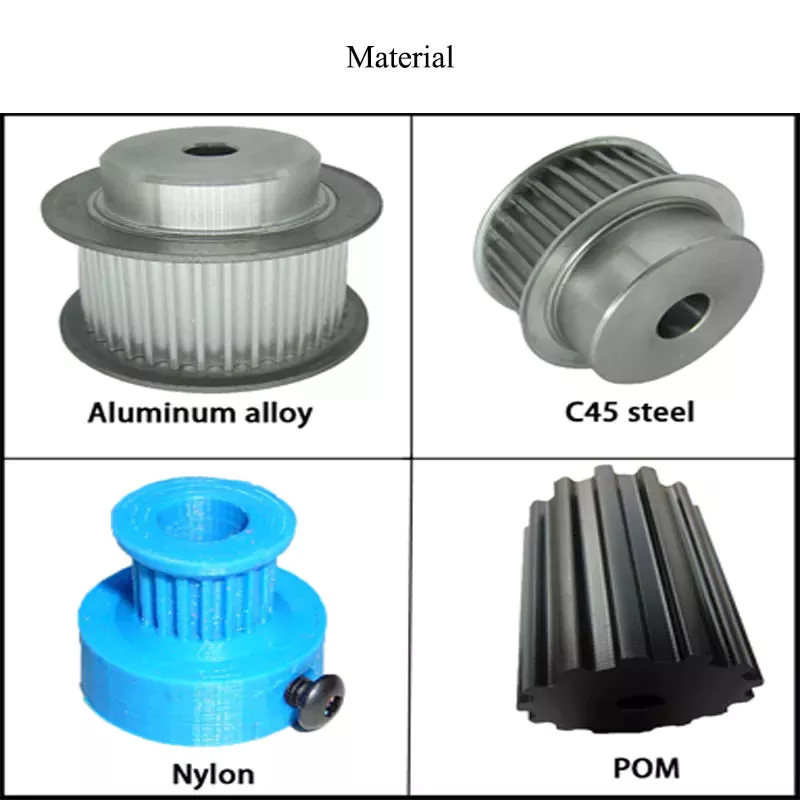
While aluminum and plastic are the most common materials for making pulleys, there are other materials to choose from for your timing pulleys. Despite their different physical properties, they all offer similar benefits. Aluminum is dense and corrosion-resistant, and plastic is lightweight and durable. Stainless steel is resistant to stains and rust, but is expensive to maintain. For this reason, aluminum is a popular choice for heavy duty pulleys.
Metal can also be used to make pulleys. Aluminum pulleys are lightweight and strong, while other materials are not as durable. CZPT produces aluminium pulleys, but can also produce other materials or special finishes. The list below is just representative of some common materials and finishes. Many different materials are used, so you should discuss the best options for your application with your engineer.
Metals such as steel and aluminum are commonly used to make pulleys. These materials are relatively light and have a low coefficient of friction. Steel pulleys are also more durable than aluminum pulleys. For heavier applications, steel and aluminum are preferred, but consider weight limitations when selecting materials. For example, metal pulleys can be used in electric motors to transmit belt motion.
pulley

cost

Replacing a tensioner in a car’s engine can cost anywhere from $90 to $300, depending on the make and model of the car. Cost can also be affected by the complexity of the pulley system and how many pulleys are required. Replacement costs may also increase depending on the severity of the damage. The cost of replacing pulleys also varies from car to car, as different manufacturers use different engines and drivetrains.
Induction motors have been an industrial workhorse for 130 years, but their cost is growing. As energy costs rise and the cost of ownership increases, these motors will only get more expensive. New technologies are now available to increase efficiency, reduce costs and improve safety standards.
The average job cost to replace an idler varies from $125 to $321, including labor. Parts and labor to replace a car pulley can range from $30 to $178. Labor and parts can cost an additional $10 to $40, depending on the make and model of the car. But the labor is worth the money because these pulleys are a critical part of a car’s engine.


China 534035810 Timing Belt Tensioner Pulley Xr842495 Lr016140 for Jaguar Land Roverr     chain pulleyChina 534035810 Timing Belt Tensioner Pulley Xr842495 Lr016140 for Jaguar Land Roverr     chain pulley
editor by czh 2023-01-18

China Chinese Supplier of Pulleys Double Wheel pulley attachments

Solution Description

Chinese Supplier of Pulleys Double Wheel
Measurement:1/2-2

Substance: Stainless Metal,Brass,Zinc Alloy

Surface treatment: Galvanized, Polishing

Application: Ship, iron and metal business, petroleum chemical sector, coal mine

Complex Specification: 

SIZE       E L N.W    
inch mm inch mm inch mm g/pcs
 1/two fifteen  3/sixteen 5  1-1/two 38 24
 3/4 twenty  3/sixteen five  1-5/8  41 39
    1     twenty five  1/4 six  2-1/eight fifty three 75
 1-1/four 32  3/8 ten 3 75 147
 1-1/two 40  3/eight 10 three seventy seven 172
50  1/2 twelve  3-7/8 ninety eight 293

Packaging & Supply:

Packing particulars: 
Bulk packing
PP Bag, Then in Carton, Pallet
In accordance to your specifications

Shipping Depth: Generally 30 days after obtaining your irrevocable L/C or progress payment. 


US $0.1-1.5
/ Piece
|
1,000 Pieces

(Min. Order)

###

Product Name: Pulleys Double Wheel
Certificate: ISO9001
Transport Package: PP Bag, Then in Carton, Pallet
Specification: 1/2-2
Trademark: First Rigging
Origin: Shandong China

###

Customization:

###

SIZE       E L N.W    
inch mm inch mm inch mm g/pcs
 1/2 15  3/16 5  1-1/2 38 24
 3/4 20  3/16 5  1-5/8  41 39
    1     25  1/4 6  2-1/8 53 75
 1-1/4 32  3/8 10 3 75 147
 1-1/2 40  3/8 10 3 77 172
50  1/2 12  3-7/8 98 293
US $0.1-1.5
/ Piece
|
1,000 Pieces

(Min. Order)

###

Product Name: Pulleys Double Wheel
Certificate: ISO9001
Transport Package: PP Bag, Then in Carton, Pallet
Specification: 1/2-2
Trademark: First Rigging
Origin: Shandong China

###

Customization:

###

SIZE       E L N.W    
inch mm inch mm inch mm g/pcs
 1/2 15  3/16 5  1-1/2 38 24
 3/4 20  3/16 5  1-5/8  41 39
    1     25  1/4 6  2-1/8 53 75
 1-1/4 32  3/8 10 3 75 147
 1-1/2 40  3/8 10 3 77 172
50  1/2 12  3-7/8 98 293

Types of pulleys and their advantages and disadvantages

There are several types of pulleys. Learn the basic equations of the pulley system. Then learn about the different uses for pulleys. The disadvantages of using pulleys will be covered. Knowing these, you can buy the pulley that suits your needs. Here are some of the best pulley types and their pros and cons.
pulley

Basic equations of pulley systems

A pulley system is a mechanism that allows two blocks of a certain mass to be connected by a taut rope. The acceleration of each block is the same in magnitude and direction. The external force acting on each block is the weight of the block (10g) and the tension in the string. The tension between the two blocks is the total tension and the force acting on the pulley is the weight of the two blocks.
This simple mechanism uses two simple equations to explain how the system works. First, the mass of the weight on both sides of the pulley must be the same. When the weight is forced to move, the rope tightens and the second pulley descends. The weight is also attached to the second pulley and must be the same distance as the first pulley. This will result in a speed ratio of 2 times the distance covered by the first pulley.
Second, we have to calculate the force required to lift the object. The lower mass is supported by a wire configuration passing through all pulleys, while the uppermost pulley is used to apply the force. The lower block is used to support the weight. The applied force needs to travel a distance nx to move the weight. This distance, called MA, can be written as:
Once we have gathered the necessary information, we can apply the calculations to the pulley system. We can also use the Mechanical Advantage Calculator to calculate the force on the anchor. To do this, we must apply a force to the load as well as to the pulley itself. Using this equation, we can calculate the force required by the load to lift the load.
pulley

Types of pulleys

There are three basic types of pulleys: movable, fixed and compound. Both types of pulleys translate the force applied to them. The ideal mechanical advantage of pulleys is two. This is because a single movable pulley only doubles the force, whereas a compound pulley doubles or triples the force. This type of pulley is often used with other types of pulleys.
Movable pulls move with the weight of the load, and the force pulling them increases on the lift side. They are often found in utility elevators and construction cranes. These systems are very simple, inexpensive and quiet to use. The force required to lift the object depends on the mechanical advantage of the system. The two most common types of pulleys are listed below. Let’s take a closer look at each one.
V-shaped pulleys are used in vehicles and electric motors. These pulleys require a “V” belt to function properly. Some have multiple “V” grooves to avoid slipping. They are used in heavy duty applications to reduce the risk of power slip. These pulleys also have more than one “V” groove. V-belt pulleys are commonly used in vehicles and electric motors.
Composite pulleys are made from more than one type of cable or rope wrapped around the wheel. They can be fixed or hinged and are usually made of stainless steel or bronze. Composite pulleys have multiple layers and can be a single unit or many different components. There are three main types of pulleys: fixed pulleys and composite pulleys. These are the most common types. Almost every type of pulley is used for some type of application.
Fixed pulleys have one advantage over movable pulleys: they change direction as the weight of the load increases. They are typically used in heavy construction equipment. Gun tackles, patio tackles, and stationary tackles are examples of equipment that use a pulley mechanism. These devices are very common and can be found on most modern construction sites. They provide great convenience for lifting large loads.

application

What are the applications of pulleys? Simply put, a pulley is a mechanical device that transforms a difficult task into an easier one. It consists of ropes and pulleys. It is usually used to lift objects. Usually, people wrap a rope around a pulley and pull up to lift the object. One disadvantage of using pulleys is that they require the same force as lifting the object directly.
One of the most popular applications of pulleys is lifting heavy objects. They help people pull up heavy objects and blocks. The system can also be used in seeders, lifts, grinders, etc. Other applications include raising flags, loading cargo, pulling curtains and rock or mountain climbing. Students can learn about the various uses of pulleys and the physics behind them.
Pulleys can be made of many different materials, depending on the application. Some are movable, which means they move with the object they are used to lift. This pulley system can be made of nylon, wire rope or fiber material. The best part about these systems is that they are easy to install and maintain. For a better grasp, use the guide or video tutorial to learn more about the pulley system and how it works.
Tapered pulleys are common in paper mills. They are high-quality pulleys that transmit power to connected parts. They can be dynamic or static and have different balances. Because pulley systems are highly customized, most industrial applications require systems designed specifically for specific applications. In this way, the system is safe, simple and inexpensive. The benefits of this design are endless.
The most common use of pulleys is for motor drives. They are used to minimize noise by applying force to the shaft to reduce the workload. They are also less expensive than gears and do not require lubrication. Furthermore, they can change the direction of the applied force. They are also less expensive than gears and are often used with other components. A screw is a cylindrical member with helical ribs used to connect something.
pulley

shortcoming

Although the pulley system makes it easier to move heavy objects, it still has some drawbacks. When using a pulley system, you must remember that the force required to lift the weight increases with the number of cycles. In addition, the distance between the puller and the heavy object increases, which may lead to accidents. Also, moving heavy objects can be tricky if the rope slips. Pulley systems are not very expensive and can be easily assembled. However, it does require a lot of space.
First, it is not efficient. Besides being inefficient, pulleys produce different forces at different speeds. Fixed pulleys use more force than the load, while movable pulleys move with the load. A movable pulley requires less force than a fixed pulley, but the combined system travels a long distance. Therefore, this method is not as efficient as the fixed method.
Pulleys are not only used in industrial processes. You can see them in various places in your daily life. For example, large construction cranes use pulleys to lift heavy loads. Even flagpoles, blinds, clotheslines, ziplines, motors and climbing equipment use pulleys. Still, despite their advantages, the disadvantages are not too serious.
Another disadvantage of the pulley is its wear and tear. While a pulley’s housing is theoretically infinite, its bearings and locking components typically wear out over time. To overcome this problem, a new bearing and locking assembly can be installed. No need to replace the housing and shaft, the entire assembly can be re-bonded and painted to replicate the original look. Alternatively, the pulley can be replaced with a new housing and shaft.
Using pulleys can also reduce the advantage of pulleys. On the other hand, interception and tackle is a system in which two pulleys are connected to each other using ropes. Unlike pulleys, pulley pulley systems can be adjusted in the direction of travel and can move heavy loads up to four times their force when used in hydraulic lifts.

China Chinese Supplier of Pulleys Double Wheel     pulley attachments	China Chinese Supplier of Pulleys Double Wheel     pulley attachments
editor by czh 2023-01-17

China Cast Iron Belt Pulley for Air Compressor engine pulley

Item Description

1) 18 years’ production experience
2)  could help customer design the mold and offer valued suggestions to reduce costs for customer
three)  PPAP documents is available if needed.
four)  OEM is welcome
five)  ISO9001:2015 certificate, ISO14001:2015 certificate, OHSAS18001:2007 certificate
 
                       
Detailed Features:                      
one.    Material: gray cast iron, nodular cast iron, austempering ductile iron (ADI, CADI), carbon steel, alloy steel, cast aluminum
two.    Casting Method: clay sand casting, resin sand casting, lost wax precision casting
three.    Heat Treatment Process: annealing, tempering, normalizing, induction hardening
four.    Machining Process: turning, milling, grinding, drilling, inserting, broaching, boring, polishing
five.   Surface treatment: anti-rust liquid&oil, painting, powder coating, zinc plating, hot-dip galvanization, phosphating, dacromat, thick-layer passivation( salt spray t0est 240hours), Ni plating, Cr Plating, etc
6.    Product Inspection: one hundred% quality control
7.    Packaging: plywood cases, cartons, steel pallets, etc.
8.    Lead time: thirty~40 days
nine.    Terms of Delivery: FOB HangZhou, CIF XXX
ten.  Place of origin: HangZhou, China
eleven.  Drawing & Software: CAD, UG, PDF, JPG, ProE, etc.
12.  Application: agricultural machinery, trucks, machine tool equipments, hydraulic pressure and pump devices, and some other fields
thirteen.  Productivity: over 10000 tons
14.  Export Markets: Germany, Britain, Italy, America, Canada, Japan and some other foreign countries

To Be Negotiated 50 Pieces
(Min. Order)

###

Certification: ISO
Pulley Sizes: Type a, Type B, Type C
Manufacturing Process: Casting
Material: Iron
Surface Treatment: Baking Paint
Application: Air Compressor

###

Samples:
US$ 1.5/kg
1 kg(Min.Order)

|
Request Sample

###

Customization:

###

1) 18 years’ production experience
2)  could help customer design the mold and offer valued suggestions to reduce costs for customer
3)  PPAP documents is available if needed.
4)  OEM is welcome
5)  ISO9001:2015 certificate, ISO14001:2015 certificate, OHSAS18001:2007 certificate
 
                       
Detailed Features:                      
1.    Material: gray cast iron, nodular cast iron, austempering ductile iron (ADI, CADI), carbon steel, alloy steel, cast aluminum
2.    Casting Method: clay sand casting, resin sand casting, lost wax precision casting
3.    Heat Treatment Process: annealing, tempering, normalizing, induction hardening
4.    Machining Process: turning, milling, grinding, drilling, inserting, broaching, boring, polishing
5.   Surface treatment: anti-rust liquid&oil, painting, powder coating, zinc plating, hot-dip galvanization, phosphating, dacromat, thick-layer passivation( salt spray t0est 240hours), Ni plating, Cr Plating, etc
6.    Product Inspection: 100% quality control
7.    Packaging: plywood cases, cartons, steel pallets, etc.
8.    Lead time: 30~40 days
9.    Terms of Delivery: FOB Qingdao, CIF XXX
10.  Place of origin: Gaomi, China
11.  Drawing & Software: CAD, UG, PDF, JPG, ProE, etc.
12.  Application: agricultural machinery, trucks, machine tool equipments, hydraulic pressure and pump devices, and some other fields
13.  Productivity: over 10000 tons
14.  Export Markets: Germany, Britain, Italy, America, Canada, Japan and some other foreign countries
To Be Negotiated 50 Pieces
(Min. Order)

###

Certification: ISO
Pulley Sizes: Type a, Type B, Type C
Manufacturing Process: Casting
Material: Iron
Surface Treatment: Baking Paint
Application: Air Compressor

###

Samples:
US$ 1.5/kg
1 kg(Min.Order)

|
Request Sample

###

Customization:

###

1) 18 years’ production experience
2)  could help customer design the mold and offer valued suggestions to reduce costs for customer
3)  PPAP documents is available if needed.
4)  OEM is welcome
5)  ISO9001:2015 certificate, ISO14001:2015 certificate, OHSAS18001:2007 certificate
 
                       
Detailed Features:                      
1.    Material: gray cast iron, nodular cast iron, austempering ductile iron (ADI, CADI), carbon steel, alloy steel, cast aluminum
2.    Casting Method: clay sand casting, resin sand casting, lost wax precision casting
3.    Heat Treatment Process: annealing, tempering, normalizing, induction hardening
4.    Machining Process: turning, milling, grinding, drilling, inserting, broaching, boring, polishing
5.   Surface treatment: anti-rust liquid&oil, painting, powder coating, zinc plating, hot-dip galvanization, phosphating, dacromat, thick-layer passivation( salt spray t0est 240hours), Ni plating, Cr Plating, etc
6.    Product Inspection: 100% quality control
7.    Packaging: plywood cases, cartons, steel pallets, etc.
8.    Lead time: 30~40 days
9.    Terms of Delivery: FOB Qingdao, CIF XXX
10.  Place of origin: Gaomi, China
11.  Drawing & Software: CAD, UG, PDF, JPG, ProE, etc.
12.  Application: agricultural machinery, trucks, machine tool equipments, hydraulic pressure and pump devices, and some other fields
13.  Productivity: over 10000 tons
14.  Export Markets: Germany, Britain, Italy, America, Canada, Japan and some other foreign countries

Pulley Type

There are several types of pulleys. These include fixed pulleys, load multipliers and movable pulleys. Below is a description of each pulley type. A load multiplier is a special type of pulley with multiple wheels for increased lifting capacity. It is used in a wide range of applications including power transmission and construction. Some common uses of pulleys are listed below.

moving pulley

Movable pulleys work by transferring the weight of a load to another object of the same mass. Since a live pulley is inherently frictionless and weightless, the force required to lift a load with it is the same as the weight of the load. This principle applies to tall buildings and residences. It is an excellent choice for lifting heavy objects such as furniture and washing machines.
A pulley is a mechanical device with a wheel that rotates on a shaft. The axle is attached to the wheel and is usually fixed. The movable pulley can be fixed or movable, both of which can change the direction of the force on the rope. Some pulleys can also change the magnitude and direction of the force. They are ideal for a variety of applications, from lifting heavy objects to transporting objects.
Another type of movable pulley works by transmitting force to another object. It has a free axis and the total force provided by the rope tension is balanced. Since the tension on the rope is constant in each segment, pulling one end of the rope will double the force on the shaft, resulting in two mechanical advantages. This mechanical advantage is the main reason why movable pulleys are so versatile.
Another form of moving pulley is called a KWL diagram. The KWL diagram summarizes the basic concepts of the drive wheel. KWL diagrams are an excellent way to assess a student’s understanding of the concepts discussed in the course. Word questions are a great way to check whether students understand concepts. When students answer the word questions correctly, the answer is yes!
pulley

Fixed wheel pulley

If you need to move heavy objects, a single fixed wheel pulley is not a good choice. Using a single fixed pulley might be similar to using a handbag, but it’s not very convenient. This type of pulley system relies on friction to transmit motion. As a result, it can slip and isn’t always reliable. Fortunately, you can find other options that work just as well.
Fixed pulleys are the most basic type of pulley. They consist of grooved wheels and ropes attached to objects. These pulleys make lifting easier. Because the rope or cable only moves in one direction, the movement of the object feels lighter. And they are also easy to install. However, before you buy a fixed wheel pulley, make sure it is strong enough to support the weight of the load.
The disadvantages of fixed pulleys are obvious. One of them is the lack of mechanical advantage. A fixed pulley pulls up with the same force as a single moving pulley, and a single fixed pulley is not particularly effective as a force multiplier. However, the effect is more pronounced when you combine multiple fixed-wheel pulleys. You will get double the power! So what do fixed wheel pulleys have to offer?
Fixed wheel pulleys can be as small as a ring. A single ring pulley requires twice as much force as the weight being pulled. Adding more loops to the rope will reduce the effort required to pull the weight. The mechanical advantage of a fixed pulley is proportional to the number of strands running to the free pulley. A 100-pound pull on the free end will lift a 300-pound load.
pulley

composite pulley

Compound pulleys are pulleys that can be used to change the direction of a control wire. It can also be used to modify the mechanical force of the wire by moving the item it is connected to. In galleons, compound pulleys are more common. They are often combined with other ropes for mechanical advantage. Here are some common uses for composite pulleys.
The ideal mechanical advantage of a pulley is equal to the number of rope segments that pull up the load. This means that the more rope segments, the less force is required. A compound pulley will have the ideal mechanical advantage of 2, which means it will generate more force than a simple pulley. Composite pulleys are also more efficient at transmitting force because their number of rope segments is usually equal to the unit weight.
Composite pulley systems use more than two pulleys and ropes. More pulleys will reduce the force required to move heavier objects. They are usually used in large sailboats. The system is also used on construction sites. It can be used for a variety of applications, including lifting large objects or transmitting electricity. You can imagine how it would change your life if you had to move a large sailboat, but the result would be the same: a composite pulley system would make it easier to lift a large sailboat.
Composite pulleys are also known as fixed pulleys. The fixed pulley is stationary, and the movable pulley moves back and forth. The latter is more effective when used with a detachable cord or strap. On the other hand, a moving pulley is a moving pulley and it gives you a mechanical advantage. You can imagine this pulley on a flagpole.

load multiplier

The multiplication system has three basic parts: the rope grab, the connector, and the pulley. While some basic multipliers may combine the three parts, the concept remains the same. The multiplication system can make pulling the rope easier by reducing the amount of friction that occurs. Below are some examples of multiplication systems. A compact rope grab is a great option for resetting the multiplier.
The load reduction that a pulley system can achieve is proportional to the number of ropes used to support it. Although most utility pulley systems use only four ropes, the theoretical maximum load reduction is a quarter of the actual load. In other words, the four-wheel system only reduces the weight of a 1,000-pound load by a quarter. That would require 167 pounds of force, a far cry from the 500-pound load a single pulley system can achieve.
The mechanical advantage of a pulley system can be calculated by calculating the ratio between the forces exerted on each wire. For example, a 90-kilogram load is supported by three ropes, each weighing about thirty-five pounds. The ropes on pulleys A and B each carry a load of 60 kg. Using this formula, a single pulley system will yield a mechanical advantage over two tractors.
To calculate the force required to pull the rope over the pulley, measure the angle and deflection between the ropes. The deflection angle when added to the included angle should equal 180 degrees. A 75 degree angle requires 159% of the load force. This means a total load multiplier of four. This formula is an important tool for calculating the force multiple of the pulley.
pulley

Disadvantages of fixed pulleys

There are two basic types of pulleys: movable and fixed. Active pulleys are more advanced, allowing the pulley to move according to the load. They reduce the force required to lift the load. Active roller pulleys are more compact and therefore take up less space. Both types are good for lifting heavier objects, but they each have their pros and cons.
Fixed wheel pulleys can be used to lift heavy objects. This type of pulley consists of a wheel with a fixed shaft that has grooves on its edges for guiding ropes or cables. This is a simple machine as no motor or engine is required to lift objects. When two or more wheels are used together, the ropes around the wheels form a powerful hoist.
Single wheel pulleys are not suitable for lifting. They tend to push things down. Also, they are unreliable because they rely on friction and can slip. Also, a single wheel pulley would require a lot of space. Another disadvantage of fixed-wheel pulleys is that they make it difficult to move heavy objects easily. Single fixed-wheel pulleys also tend to slip easily, making them a poor choice for many applications.
Fixed wheel pulleys are also easier to install and maintain than manually operated ones. It requires less space and lubrication than manual pulleys. Manual pulleys can cause injury because the operator will be lifting the full weight of the heavy object. Additionally, rope slippage can lead to muscle strains and rope burns. And the system requires frequent maintenance.

China Cast Iron Belt Pulley for Air Compressor     engine pulleyChina Cast Iron Belt Pulley for Air Compressor     engine pulley
editor by czh 2023-01-16

China China Foundry, Green Sand Casting Process Belt Pulley pulley and belt

Product Description

Firm INTRODUCTION

HangZhou Really worth Engineering Engineering Co., Ltd. started in 2001 , Organization is situated in the Chinese ancient city — HangZhou. Our organization has been engaged in generating customized made engineering components, OEM/ODM spare components and industrial components for many years, like sand casting parts and investment casting spare parts, forging areas, sheet steel stamping spare areas, machined parts and plastic parts, which are extensively used in petrochemical, auto, chemical, environmental security , machinery, construction, agriculture, aerospace, maritime hardware and other industries.


Grey IRON/DUCTILE IRON/CARBON Steel/ALLOY Steel SAND CASTING
 

Sand casting accessories and cnc machining part for engine, refrigerator and air conditioner, fan, compressor, pump, flange, washer, coupling, gearbox case, shaft, valve and strainer, tractor, automotive, motor rotor, electronic case, computer,  water treatment equipment. Weight of products range from 0.5kgs to 10tons. The usually used materials are ductile iron, gray iron, high chrome iron, many kinds of steel, brass, copper, aluminum and wear resistant material, etc.
Approach: sand casting+cnc machining+deburrs
Tolerance: +/-.05mm
Floor: deburrs,degrease,chamfer
Service available: OEM & ODM
Quality control: 0 defects,a hundred% inspection before packing
Delivery time: 30 days after confirm the drawing
Packing:   Inner:bubble poly bag Outer:5 layers ctn box or poly wooden box/pallet
Logistics service:  sea,air,express,EXW,FOB,CIF,DDU,DDP

Warranty:   100% refund or replacement for NOK pcs

Our Services

one, R&D service                       2, Drawing design service
three, Samples service                  4, Bulk production service
five, Inspection service               6, Packing&shipping service

Packaging & Shipping

one.Packing: 
Inside:bubble bag
Exterior:carton case or poly wooden case
2.Shipping: 
Small batch by courier, large batch by sea or air

Certifications

1. ISO9001-2008
two. SGS
3. Material Certificate
four. CIQ…

Company Capabilities:

(1).CNC machining parts
(2).The fabrication
(3).The mechanical assemble
(4).The Surface treatment

Plating :3+Cr,environmental,anti-corrosion maximum 480 hours salt spray test
Coating:powder coating,electrcial coating,maximum 480 hours salt spray test
Painting:environmental EXPOSY painting,cross-cutting test
Polish:satin polish,mirror polish,electrical polish, maximum 1200 grid
Dacromet:evironmental,anti-corrosion,maximum 560 hours salt spary test
Anodization:tumble,shot blast,sand blast…..,various color,maximum 480 hours salt spray test
Nylok:limited-locking,environmental,5 million times
Heat Treatment:adjust the mechanical properties,mood,normalization,quench……
(5).The Variousl Material
stainless steel:SS304,SS304L,SS316,SS316L,SS430,SS201……
aluminium:7075,6061,6063,5082,5051,2014…….
brass:H62,H58,H59……
metal:C20,C45,C60,C35……
steel alloy:25CrMo,42CrMo,25Cr,40Cr,Q345,11SMn30……
iron cast:QT600,QT250,HT450,HT150……
titanium alloy:GR2,GR5,GR7,GR9……
tungsten alloy:WuNiFe alloy,Carbide Wolfram……
the blanks:stamping parts,forging parts,die casting parts,profile,extrusion……

the plastic:PP,PE,POM,Acrylic,Abdominal muscles,Delrin……


Company EQUIPMENTS

THE Deal AND Cargo

Clients


US $1-50
/ Piece
|
1,000 Pieces

(Min. Order)

###

Type: Chemical Hardening Sand
Casting Method: Thermal Gravity Casting
Sand Core Type: Resin Sand Core
Application: Agricultural Machinery Parts
Machining: CNC Machining
Material: Iron

###

Customization:
US $1-50
/ Piece
|
1,000 Pieces

(Min. Order)

###

Type: Chemical Hardening Sand
Casting Method: Thermal Gravity Casting
Sand Core Type: Resin Sand Core
Application: Agricultural Machinery Parts
Machining: CNC Machining
Material: Iron

###

Customization:

What is a pulley?

Pulleys are shafts or wheels on a shaft that support the movement and change of direction of a taut cable. The pulley also transfers power from the shaft to the cable. A simple pulley is used to raise the school flag. Read on to learn about the basic types of pulleys. We also covered the use of pulleys in everyday life. Read on to learn more about this important mechanical part.
pulley

composite pulley

A composite pulley is a mechanical system where two or more pulleys and ropes are connected together. It reduces the force required to lift the load because the force is divided by the distance of each pulley. Distance is equal to the mass of the object. Composite pulleys are a common mechanical system on sailboats. Composite pulleys can be used to lift heavy equipment such as sails.
The compound pulley unit consists of two pulleys, one fixed and the other movable. The fixed pulley is fixed overhead, while the movable pulley is connected to the load by a chain. The lift applies force to the other end of the rope. Anchor points are attached to fixed joists, ceiling joists or sturdy branches. The chain should be long enough to support the load during lifting.
Composite pulleys can be made from a variety of materials. Some are fixed and remain fixed. Others are detachable. The composite pulley combines the advantages of both types, making it a versatile tool. In the table below, these three types of pulleys are compared. It’s easy to see which one is best for your needs. The right choice depends on your specific needs and budget.
The compound pulley system consists of two fixed pulleys and one movable pulley. The compound pulley system multiplies the force by a factor of 2. The compound pulley system is particularly suitable for heavy loads and is ideal for construction sites. Workers apply less than half the load force on the composite pulley, significantly reducing the force required. This is a major benefit for many people.

Fixed pulley

Fixed pulleys are fixed gears of fixed length that are mounted on solid objects. There are many different types of pulley systems. Some cooperate with each other, but not “fixed”.
Fixed pulleys can be used for a variety of purposes. One application is to lift small objects. They have a one-to-one mechanical advantage. Often, a single pulley can lift small loads. The force required to lift a single fixed pulley remains the same. They are usually used to lift lighter objects. They can even be attached to buckets used to draw water from wells.
While single fixed pulleys have desirable mechanical advantages, they are not suitable for force multipliers. Because their mechanical advantage diminishes over time, they are not effective force multipliers. They are used to redirect work so that it can be applied in the most convenient direction. This mechanical advantage is the main advantage of fixed pulleys and the most common way of moving objects. They have several benefits, including the ability to increase the speed of moving objects.
Another application for fixed pulleys is lifting supplies. A scaffold can weigh more than one and can be directly hoisted. In order to facilitate the transportation of materials, fixed pulleys are usually installed on the top of the scaffolding on construction sites. Then thread the rope through the edge of the groove that holds the pulley. The fixed pulley exerts the same force on the pull side as on the push side. The same is true for moving objects with fixed pulleys.
pulley

moving pulley

A movable pulley is a device whose part is fixed to another object, usually a rod or beam. The movable part moves with the load, making the load feel lighter. This is a useful tool for those who need to carry heavy items such as large bags. The advantages of moving pulleys are many. Here are some of them. Read on to learn more about them.
One of the most common uses of movable pulley systems is climbing high objects. Climbers act as pulley loads and pull ropes to lift objects. Eventually, when the traction stops, the climber descends. However, it is still a useful tool in other situations. The movable pulley system can help you climb the tallest objects or lift them to level surfaces.
Another example of movable pulleys is in industry. Depending on the load, movable pulleys make handling and moving loads easier. You can use them in a variety of applications in manufacturing and industry, including cleaning. For example, the American flag is raised and lowered every day. Removable pulleys are a handy tool when buildings need cleaning.
If you’re not sure whether a task requires a pulley, a zipline might be a good option. Connect the two ends of the rope and the pulley will move along the rope, then attach the rope to the metal cable. The load is the person holding the pulley, and the force comes from the attachment on the other end of the rope. There are two types of live pulleys: simple pulleys with just one wheel and live pulleys with many ropes attached.

School flag raised with simple pulleys

How is the school flag raised? It is pulled up by a rope attached to a pulley at the top of the pole. When the rope is pulled, the pulley turns, raising the flag. A pulley is a simple mechanism that helps people move heavier objects with ease. The rope must be securely attached to the pulley to keep the flag stable.
A simple pulley is a spinning wheel with grooves on one side and ropes on the other. The rope can be any length and the wheels can be any size. The rope has to go through the groove and the load is attached to the other end of the rope. Simple pulleys are pulleys with fixed shafts. An example is the wheel on a school flagpole.
A simple pulley system consists of a primary pole, a secondary pole and an outer member. The primary flagpole is connected to the track by a detour, while the secondary flagpole is connected to the track by a pipe. There is a groove on one side of the track, which passes through the inner cavity of the flagpole. An open track at the upper end of the track connects the two parts of the pulley.
A simple pulley can be used for many purposes. This is a useful machine that can be used to raise the flag. Among other things, it can be used in clothing lines, bird feeders, and even roofers. And, of course, you can use the pulley to raise the flag. Its versatility makes it an essential part of school decor.
pulley

cast iron pulley

If you are looking for pulleys for your machine, you may come across cast iron pulleys. They are usually cheap and available in a variety of sizes. The rim is held in place by a mesh attached to a central boss. The arms and spokes can be straight or curved, but most are oval. There are many uses for this type of pulley.
You might wonder why the arms of cast iron pulleys are so curved. Bent arms tend to yield rather than break. Cast iron pulleys are usually round with a slight bump on the rim, which helps keep the belt centered on the rim as it moves. On a 300mm diameter pulley, the bumps may be as small as 9mm.

China China Foundry, Green Sand Casting Process Belt Pulley     pulley and belt	China China Foundry, Green Sand Casting Process Belt Pulley     pulley and belt
editor by czh 2023-01-15

China OEM Aluminium Timing Belt Synchronous Pulley with Great quality

Solution Description

>> If you get quality issues with the merchandise, you should make contact with us in time and deal with it properly for you.

>> You want to provide enamel profile, enamel quantity, belt width, bore diameter, quantity and type. Make sure you send us drawings to get our very best quotation.Thanks
 

Solution identify Belt pulley / Timing pulley
Enamel profile Arc toothed HTD3M, HTD5M, HTD8M, HTD14M, HTD20M, Gt2,  Gt3, Gt5
Arc Gt toothed Gt2,Gt3,Gt5
Trapezoidal toothed MXL, XXL, XL, L, H, XH, XXH
T-toothed T2.5, T5, T10, T20
AT-toothed AT3,AT5,AT10,AT20
S-toothed S2M, S3M, S4.5M, S5M, S8M, S14M
Parabolic-toothed P2M, P3M, P5M, P8M, P14M
Y-toothed G2M, G3M, G5M, Y8M
Teeth Quantity 10-a hundred and fifty enamel or custom-made
Inner Bore 2-200mm H7 precision or custom-made
materials Carbon metal, aluminum alloy frequently utilized, brass and forged iron accessible.
Surface area treatment method Anodize, Black Oxide, Phosphate and Galvanization.
Specification OEM serice, strictly in accordance drawing and samples
Software Machining, Mining Accessories, Equipment Accessoried, Truck Elements, Car Elements, Industrial Components, etc


     FEATURE#one
      – Accurate transmission
      – Balance
      – Reduced sounds
      – No slip
     FEATURE#two
      – Multi-axis transmission
      – Oil resistant
      – Dampness evidence
      – No lubication needed
     FEATURE#3
      – Basic safety & Eco-friendly
      – Extensive selection of apps
      – Assistance customization

HangZhou CZPT Rubber & Plastic Co.,Ltd  
Proven in 2008, Is a Specializing in the creation of agricultural/industrial equipment areas, currently producing timing belts, conveyor belts, crawlers, synchronous wheels, gears, bearings, engines and other spare elements. Our products are SGS, RoHS, M1 and UL qualified,Our factory is positioned in Zhangting Industrial Zone, Xihu (West Lake) Dis., HangZhou, which is only fifty kilometers absent from the popular HangZhou Port (Harbor). addresses an location of 9,000 sq. meters, with 6,000 sq. meters’ normal workshops and planet-class products, we have exported our products to a lot of intercontinental markets such as the United kingdom, Southeast Asia, France, Australia, Canada, and many others.You should truly feel cost-free to speak to us for more details.

====================================  FAQ ======================================

1) Q: I have not carried out enterprise with you before, how can i believe in your organization? 
A: Our firm are produced-in-china golden supplier and passed Subject certification by produced-in-china. What is actually much more,we’ve acquired authority certificates for ISO9001.

two) Q: How is top quality ensured?
A:  All our procedures strictly adhere to ISO9001:2008 techniques, we have strict quality management from generating to shipping and delivery,100% inspection by skilled tests centre. Tiny samples could be provided to you for tests.

3) Q: Can i get 1 or more samples?
A: Indeed, sample orders welcomed. 

4) Q: Do you give any reductions?
A: Yes, we will surely consider my ideal to support you get the ideal price tag and very best service at the same time.

five) Q: How to Custom made-made(OEM/ODM)?
A: Please ship you solution drawings or samples to us if you have, and we can custom made-produced as you specifications.We will also supply professional advices of the products to make the design to be improve the efficiency.

US $1-8
/ Piece
|
100 Pieces

(Min. Order)

###

Certification: CE, ISO
Manufacturing Process: Hobbing
Material: C45#Steel,Brass,Aluminum, POM
Surface Treatment: Baking Paint
Application: Chemical Industry, Grain Transport, Mining Transport, Power Plant, Industrial Agricultural Machinery  
Name: Timing Pulley

###

Samples:
US$ 30/Piece
1 Piece(Min.Order)

|
Request Sample

###

Customization:

###

Product name Belt pulley / Timing pulley
Teeth profile Arc toothed HTD3M, HTD5M, HTD8M, HTD14M, HTD20M, Gt2,  Gt3, Gt5
Arc Gt toothed Gt2,Gt3,Gt5
Trapezoidal toothed MXL, XXL, XL, L, H, XH, XXH
T-toothed T2.5, T5, T10, T20
AT-toothed AT3,AT5,AT10,AT20
S-toothed S2M, S3M, S4.5M, S5M, S8M, S14M
Parabolic-toothed P2M, P3M, P5M, P8M, P14M
Y-toothed G2M, G3M, G5M, Y8M
Teeth Quantity 10-150 teeth or customized
Inner Bore 2-200mm H7 precision or customized
materials Carbon steel, aluminum alloy frequently used, brass and cast iron available.
Surface treatment Anodize, Black Oxide, Phosphate and Galvanization.
Specification OEM serice, strictly according drawing and samples
Application Machining, Mining Accessories, Machinery Accessoried, Truck Parts, Auto Parts, Industrial Parts, etc

###

OEM Aluminium Timing Belt Synchronous Pulley      FEATURE#1
      – Accurate transmission
      – Balance
      – Low noise
      – No slip
     FEATURE#2
      – Multi-axis transmission
      – Oil resistant
      – Moisture proof
      – No lubication required
OEM Aluminium Timing Belt Synchronous Pulley
OEM Aluminium Timing Belt Synchronous Pulley      FEATURE#3
      – Safety & Eco-friendly
      – Wide range of applications
      – Support customization
US $1-8
/ Piece
|
100 Pieces

(Min. Order)

###

Certification: CE, ISO
Manufacturing Process: Hobbing
Material: C45#Steel,Brass,Aluminum, POM
Surface Treatment: Baking Paint
Application: Chemical Industry, Grain Transport, Mining Transport, Power Plant, Industrial Agricultural Machinery  
Name: Timing Pulley

###

Samples:
US$ 30/Piece
1 Piece(Min.Order)

|
Request Sample

###

Customization:

###

Product name Belt pulley / Timing pulley
Teeth profile Arc toothed HTD3M, HTD5M, HTD8M, HTD14M, HTD20M, Gt2,  Gt3, Gt5
Arc Gt toothed Gt2,Gt3,Gt5
Trapezoidal toothed MXL, XXL, XL, L, H, XH, XXH
T-toothed T2.5, T5, T10, T20
AT-toothed AT3,AT5,AT10,AT20
S-toothed S2M, S3M, S4.5M, S5M, S8M, S14M
Parabolic-toothed P2M, P3M, P5M, P8M, P14M
Y-toothed G2M, G3M, G5M, Y8M
Teeth Quantity 10-150 teeth or customized
Inner Bore 2-200mm H7 precision or customized
materials Carbon steel, aluminum alloy frequently used, brass and cast iron available.
Surface treatment Anodize, Black Oxide, Phosphate and Galvanization.
Specification OEM serice, strictly according drawing and samples
Application Machining, Mining Accessories, Machinery Accessoried, Truck Parts, Auto Parts, Industrial Parts, etc

###

OEM Aluminium Timing Belt Synchronous Pulley      FEATURE#1
      – Accurate transmission
      – Balance
      – Low noise
      – No slip
     FEATURE#2
      – Multi-axis transmission
      – Oil resistant
      – Moisture proof
      – No lubication required
OEM Aluminium Timing Belt Synchronous Pulley
OEM Aluminium Timing Belt Synchronous Pulley      FEATURE#3
      – Safety & Eco-friendly
      – Wide range of applications
      – Support customization

How to use the pulley system

Using a pulley system is a great way to move things around your home, but how do you use a pulley system? Let’s look at the basic equations that describe a pulley system, the types of pulleys, and some safety considerations when using pulleys. Here are some examples. Don’t worry, you’ll find all the information you need in one place!
pulley

Basic equations of pulley systems

The pulley system consists of pulleys and chords. When the weight of the load is pulled through the rope, it slides through the groove and ends up on the other side. When the weight moves, the applied force must travel nx distance. The distance is in meters. If there are four pulleys, the distance the rope will travel will be 2×24. If there are n pulleys, the distance traveled by the weight will be 2n – 1.
The mechanical advantage of the pulley system increases with distance. The greater the distance over which the force is applied, the greater the leverage of the system. For example, if a set of pulleys is used to lift the load, one should be attached to the load and the other to the stand. The load itself does not move. Therefore, the distance between the blocks must be shortened, and the length of the line circulating between the pulleys must be shortened.
Another way to think about the acceleration of a pulley system is to think of ropes and ropes as massless and frictionless. Assuming the rope and pulley are massless, they should have the same magnitude and direction of motion. However, in this case the quality of the string is a variable that is not overdone. Therefore, the tension vector on the block is labeled with the same variable name as the pulley.
The calculation of the pulley system is relatively simple. Five mechanical advantages of the pulley system can be found. This is because the number of ropes supporting the load is equal to the force exerted on the ropes. When the ropes all move in the same direction, they have two mechanical advantages. Alternatively, you can use a combination of movable and fixed pulleys to reduce the force.
When calculating forces in a pulley system, you can use Newton’s laws of motion. Newton’s second law deals with acceleration and force. The fourth law tells us that tension and gravity are in equilibrium. This is useful if you need to lift heavy objects. The laws of motion help with calculations and can help you better understand pulley systems.
pulley

Types of pulleys

Different types of pulleys are commonly used for various purposes, including lifting. Some pulleys are flexible, which means they can move freely around a central axis and can change the direction of force. Some are fixed, such as hinges, and are usually used for heavier loads. Others are movable, such as coiled ropes. Whatever the purpose, pulleys are very useful in raising and lowering objects.
Pulleys are common in many different applications, from elevators and cargo lift systems to lights and curtains. They are also used in sewing machine motors and sliding doors. Garage and patio doors are often equipped with pulleys. Rock climbers use a pulley system to climb rocks safely. These pulley systems have different types of pinions that allow them to balance weight and force direction.
The most common type of pulley is the pulley pulley system. The pulley system utilizes mechanical advantages to lift weight. Archimedes is thought to have discovered the pulley around 250 BC. in ancient Sicily. Mesopotamians also used pulleys, they used ropes to lift water and windmills. Pulley systems can even be found at Stonehenge.
Another type of pulley is called a compound pulley. It consists of a set of parallel pulleys that increase the force required to move large objects. This type is most commonly used in rock climbing and sailing, while composite pulleys can also be found in theater curtains. If you’re wondering the difference between these two types of pulleys, here’s a quick overview:

Mechanical Advantages of Pulley Systems

Pulley systems offer significant mechanical advantages. The ability of the system to reduce the effort required to lift weights increases with the number of rope loops. This advantage is proportional to the number of loops in the system. If the rope had only one loop, then a single weight would require the same amount of force to pull. But by adding extra cycles, the force required will be reduced.
The pulley system has the advantage of changing the direction of the force. This makes it easier to move heavy objects. They come in both fixed and mobile. Pulleys are used in many engineering applications because they can be combined with other mechanisms. If you want to know what a pulley can do, read on! Here are some examples. Therefore, you will understand how they are used in engineering.
Single-acting pulleys do not change direction, but compound pulleys do. Their mechanical advantage is six. The compound pulley system consists of a movable pulley and a fixed pulley. The mechanical advantage of the pulley system increases as the number of movable wheels decreases. So if you have two wheels, you need twice as much force to lift the same weight because you need a movable pulley.
The mechanical advantage of a pulley system can be maximized by adding more pulleys or rope lengths. For example, if you have a single pulley system, the mechanical advantage is one of the smallest. By using two or three pulleys, up to five times the mechanical advantage can be achieved. You can also gain up to ten times the mechanical advantage by using multiple pulley systems.
The use of a single movable pulley system also adds to the mechanical advantage of the pulley system. In this case, you don’t have to change the direction of the force to lift the weight. In contrast, a movable pulley system requires you to move the rope farther to generate the same force. Using a compound pulley system allows you to lift heavy loads with ease.
pulley

Safety Issues When Using Pulley Systems

Pulleys have an incredibly unique structure, consisting of a disc with a groove in the middle and a shaft running through it. A rope or cord is attached to one end of a pulley that turns when force is applied. The other end of the rope is attached to the load. This mechanical advantage means that it is much easier to pull an object using the pulley system than to lift the same object by hand.
Although pulley systems are a common part of many manufacturing processes, some employers do not train their workers to use them properly or install protection to prevent injury. It is important to wear proper PPE and follow standard laboratory safety practices during pulley system activities. Make sure any support structures are strong enough to handle the weight and weight of the rope or rope. If you do fall, be sure to contact your employer immediately.

China OEM Aluminium Timing Belt Synchronous Pulley     with Great quality China OEM Aluminium Timing Belt Synchronous Pulley     with Great quality
editor by czh 2023-01-14

China 608zz Bearing Nylon Pulley for Sliding Window and Door Accessories with Great quality

Item Description

Product name 608zz bearing nylon  pulley for sliding window and doorway accessories
Design amount window and doorway pulley
Bore dimension 5-10mm
Outside the house dimensions five-50mm
Bearing substance Chrome steel, carbon metal, iron, large carbon steel
MOQ 5000 PCS
Price tag conditions EXW, FOB, CIF
Payment phrases T/T, L/C, Paypal, Credit history card
Creation time Is dependent on the quantity, generally 35-45 days.
Package deal PE bag+white box+outer carton+pallet, or as customers’ necessity.
Application Utilized in doorway, window, furniture and sports tools.

one. Prolonged lifestyle and large top quality.

two. Large precision, minimal sounds with stringent controling of the high quality.

three. High loading by the innovative large-technological style.

4. Most competitive cost, manufacturing unit direct.

5. OEM provider provided, to fulfill the customer’s requrements.

one. Pre-sale provider: Our specialist income will reply your inquiry inside of 48 hours and introduce the framework and use of the products.

two. On-buy service: Soon after clients positioned the order, we will put together the goods ASAP to make confident the supply on time. Any hold off will be notified in progress.

three. Right after-sale support: If there is any hurt in the course of supply, the value will be taken by our company and if there is problem throughout the guarantee interval, we will exchange or refund it.

4. OEM services: We have advanced technological innovation and skilled technicians to assist the specialist customized all types of bearing to meet up with different requirements.

Q: Are your organization is a buying and selling firm or manufacturer?

A:We have our own manufacturing facility as well we do the trade by our selves.

Q:How long is your delivery time?

A:Usually 5-10 days if we have the stock,if not,it will be twenty five-35 days. But it often rely on the amount.

Q:Do you supply the free samples?

A:Yes,we’d like to.But you want to spend the freight payment,or we will return the cost when acquiring your buy.

Q:Can you do the OEM/ODM services?

A:Of program we can,We can be personalized in accordance to your demands or drawings.


To Be Negotiated 5,000 Pieces
(Min. Order)

###

Certification: CE
Splittable: Splittable
Material: Steel
Transport Package: Carton
Specification: 6*19*6
Trademark: N/M

###

Samples:
US$ 0.1/Piece
1 Piece(Min.Order)

|
Request Sample

###

Customization:

###

Product name 608zz bearing nylon  pulley for sliding window and door accessories
Model number window and door pulley
Bore size 5-10mm
Outside size 5-50mm
Bearing material Chrome steel, carbon steel, iron, high carbon steel
MOQ 5000 PCS
Price terms EXW, FOB, CIF
Payment terms T/T, L/C, Paypal, Credit card
Production time Depends on the quantity, normally 35-45 days.
Package PE bag+white box+outer carton+pallet, or as customers’ requirement.
Application Used in door, window, furniture and sports equipment.
To Be Negotiated 5,000 Pieces
(Min. Order)

###

Certification: CE
Splittable: Splittable
Material: Steel
Transport Package: Carton
Specification: 6*19*6
Trademark: N/M

###

Samples:
US$ 0.1/Piece
1 Piece(Min.Order)

|
Request Sample

###

Customization:

###

Product name 608zz bearing nylon  pulley for sliding window and door accessories
Model number window and door pulley
Bore size 5-10mm
Outside size 5-50mm
Bearing material Chrome steel, carbon steel, iron, high carbon steel
MOQ 5000 PCS
Price terms EXW, FOB, CIF
Payment terms T/T, L/C, Paypal, Credit card
Production time Depends on the quantity, normally 35-45 days.
Package PE bag+white box+outer carton+pallet, or as customers’ requirement.
Application Used in door, window, furniture and sports equipment.

Mechanical advantages of pulleys

A pulley is a mechanical device used to transmit motion. The device has a variety of uses, including lifting heavy objects. In this article, we will discuss the mechanical advantages, types, common uses and safety considerations of pulleys. We’ll also discuss how to identify pulleys and their components, and what to look out for when using pulleys. Read on to learn more about pulleys.
pulley

Mechanical advantages of pulleys

The mechanical advantage of pulleys is that they change the direction of force from one direction to another. In this way, the person lifting the heavy object can change its position with minimal effort. The pulleys are also easy to install and require no lubrication after installation. They are also relatively cheap. Combinations of pulleys and cables can be used to change the direction of the load.
The mechanical advantage of a pulley system increases with the number of ropes used in the system. The more cycles a system has, the more efficient it is. If the system had only one rope, the force required to pull the weight would be equal. By adding a second rope, the effort required to pull the weight is reduced. This increase in efficiency is known as the mechanical advantage of the pulley.
Pulleys have many uses. For example, ziplines are one application. This is a good example of pulleys in use today. Pulley systems can be complex and require a lot of space. Using ziplines as an example, advanced students can calculate the mechanical advantage of multiple pulleys by dividing the work done by each pulley by the remainder or fraction. Regents at the University of Colorado created a zipline with K-12 input.
Another use for pulleys is weight lifting. This technique is very effective when using multiple strands of rope. A single rope going from one pulley to the other with just two hands is not enough to lift heavy objects. Using a pulley system will greatly increase the force you receive. This power is multiplied over a larger area. So your lifting force will be much greater than the force exerted by a single rope.
The pulley is a great invention with many uses. For example, when lifting heavy objects, pulleys are a great way to get the job done, and it’s easier to do than one person. The pulley is fixed on a hinge and rotates on a shaft or shaft. Then pull the rope down to lift the object. A pulley assembly will make the task easier. In addition, it will also allow power to be transferred from one rotary shaft to another.
pulley

Types of pulleys

If you are an engineer, you must have come across different types of pulleys. Some pulleys come in multiple types, but a typical pulley has only one type. These types of pulleys are used in various industrial processes. Here are some common types of pulleys that engineers encounter on the job. In addition to the above, there are many more. If you haven’t seen them in practice, you can check out a list of the different types below.
Fixed pulleys: Fixed pulleys have a roller attached to a fixed point. The force required to pull the load through the fixed pulley is the same as the force required to lift the object. Movable pulleys allow you to change the direction of the force, for example, by moving it laterally. Likewise, movable pulleys can be used to move heavy objects up and down. Commonly used in multi-purpose elevators, cranes and weight lifters.
Composite pulleys combine fixed and movable pulleys. This combination adds to the mechanical advantage of both systems. It can also change the direction of the force, making it easier to handle large loads. This article discusses the different types of pulleys used for lifting and moving. Braided pulleys are an example of these pulleys. They combine the advantages of both types.
A simple pulley consists of one or more wheels, which allow it to reverse the direction of the force used to lift the load. On the other hand, dual-wheel pulleys can help lift twice the weight. By combining multiple materials into one pulley, a higher ME will be required. Regardless of the type of pulley, understanding the principles behind it is critical.
Pulleys are an important part of construction and mechanical engineering, and their use dates back to Archimedes. They are a common feature of oil derricks and escalators. The main use of pulleys is to move heavy objects such as boats. In addition to this, they are used in other applications such as extending ladders and lifting heavy objects. The pulley also controls the aircraft rudder, which is important in many different applications.

Commonly used

Common uses for pulleys are varied. Pulley systems are found throughout most areas of the house, from adjustable clotheslines to motor pulleys in different machines. Commercially, one of the most common uses is for cranes. Cranes are equipped with pulleys to lift heavy objects. It is also common to use pulley systems in tall buildings, which allow tall buildings to move with relative ease.
Pulleys are commonly used in interception and zipline systems, where a continuous rope around the pulley transmits force. Depending on the application, the rope is either light or strong. Pulleys are formed by wrapping a rope around a set of wheels. The rope pulls the object in the direction of the applied force. Some elevators use this system. Pull a cable on one end and attach a counterweight on the other end.
Another common use for pulleys is to move heavy objects. Pulleys mounted on walls, ceilings or other objects can lift heavy objects like heavy toolboxes or 2×4 planks. The device can also be used to transfer power from one rotating shaft to another. When used to lift heavy objects, pulleys can be used to help you achieve your goals of a good workout.
Pulley systems have a variety of uses, from the most basic to the most advanced. Its popularity is indisputable and it is used in different industries. A good example is timing belts. These pulleys transmit power to other components in the same direction. They can also be static or dynamic depending on the needs of the machine. In most cases, the pulley system is custom made for the job.
Pulley systems can be simple or complex, but all three systems transfer energy efficiently. In most cases, the mechanical advantage of a single pulley is 1 and the mechanical advantage of a single active pulley is 2. On the other hand, a single live pulley only doubles the force. This means you can trade effort for distance. Pulleys are the perfect solution for many common applications.
pulley

Safety Notice

If you use pulleys, you need to take some safety precautions. First, make sure you’re wearing the correct protective gear. A hard hat is a must to avoid being hit by falling objects. You may also want to wear gloves for added protection. You should also maintain a good distance from the pulley so that nearby people can walk around it safely.
Another important safety measure to take before using a chain hoist is to barricade the area to be lifted. Use marker lines to prevent the load from sliding when moving horizontally. Finally, use only the sprocket set for vertical lift. Always install shackle pins before lifting. You should also wear personal protective equipment such as earplugs and safety glasses when using the chain hoist.
In addition to these safety measures, you should also use cables made from aerospace-grade nylon. They will last many cycles and are made of high quality materials. Also, make sure the cables are lubricated. These measures reduce friction and corrosion. No matter what industry you are in, be sure to follow these precautions to ensure a long service life for your cables. Consult the cable manufacturer if you are unsure of the appropriate material. A company with 60 years of experience in the cable industry can recommend the right material for your system.

China 608zz Bearing Nylon Pulley for Sliding Window and Door Accessories     with Great quality China 608zz Bearing Nylon Pulley for Sliding Window and Door Accessories     with Great quality
editor by czh 2023-01-13

China Accepted by Big Distributors and Wholesalers Belt Tensioner Pulley Apv1074 Vkm32301 T36396  532029810 504000412 belt pulley

Item Description


Market EU,North The united states,Mid-East,South America,Asia Manufacturing OEM & ODM
 Packing Neutral or Customize Application Car Engine
Shipping and delivery seven-twenty times Port HangZhou,ZheJiang
Warranty thirty,000KM fifty,000KM or 80,000KM Certificate IATF 16949:2016


Why we are better?
one.Lanhai specialized in manufacturing bearings for automotive tensioner,alternator,AC compressor and unique size things,providing to 65% tensioner factories in China.Why they have faith in us?just since of reliable good quality and support.

2.Buyers from twelve international locations made good income by promoting our items.Very first course high quality and service with second course price tag is our promise.

three.The lifetime of grease reaches 1000h in sturdiness take a look at.NBR sealing ring continually operating a lot more than 100h realize 140ºC.ACM sealing materials passed 500h sturdiness check.

4.Regular things one hundred% automatic manufacturing, specific objects automation and semi-automation fee reached a lot more than ninety%.

five.Large efficiency on new product developing and limited generation supply time.

US $1.5-3
/ Piece
|
10 Pieces

(Min. Order)

###

After-sales Service: Professional Technician and Manufacturing Team
Warranty: 50, 000-80, 000 Km
Standard: Genuine Quality
Marketing: Aftermarket
Transport Package: Plastic Bag + Individual Box
Trademark: OEM

###

Customization:

###

Market EU,North America,Mid-East,South America,Asia Manufacturing OEM & ODM
 Packing Neutral or Customize Application Auto Engine
Delivery 7-20 days Port Ningbo,Shanghai
Warranty 30,000KM 50,000KM or 80,000KM Certificate IATF 16949:2016
US $1.5-3
/ Piece
|
10 Pieces

(Min. Order)

###

After-sales Service: Professional Technician and Manufacturing Team
Warranty: 50, 000-80, 000 Km
Standard: Genuine Quality
Marketing: Aftermarket
Transport Package: Plastic Bag + Individual Box
Trademark: OEM

###

Customization:

###

Market EU,North America,Mid-East,South America,Asia Manufacturing OEM & ODM
 Packing Neutral or Customize Application Auto Engine
Delivery 7-20 days Port Ningbo,Shanghai
Warranty 30,000KM 50,000KM or 80,000KM Certificate IATF 16949:2016

Mechanical advantages of pulleys

A pulley is a mechanical device used to transmit motion. The device has a variety of uses, including lifting heavy objects. In this article, we will discuss the mechanical advantages, types, common uses and safety considerations of pulleys. We’ll also discuss how to identify pulleys and their components, and what to look out for when using pulleys. Read on to learn more about pulleys.
pulley

Mechanical advantages of pulleys

The mechanical advantage of pulleys is that they change the direction of force from one direction to another. In this way, the person lifting the heavy object can change its position with minimal effort. The pulleys are also easy to install and require no lubrication after installation. They are also relatively cheap. Combinations of pulleys and cables can be used to change the direction of the load.
The mechanical advantage of a pulley system increases with the number of ropes used in the system. The more cycles a system has, the more efficient it is. If the system had only one rope, the force required to pull the weight would be equal. By adding a second rope, the effort required to pull the weight is reduced. This increase in efficiency is known as the mechanical advantage of the pulley.
Pulleys have many uses. For example, ziplines are one application. This is a good example of pulleys in use today. Pulley systems can be complex and require a lot of space. Using ziplines as an example, advanced students can calculate the mechanical advantage of multiple pulleys by dividing the work done by each pulley by the remainder or fraction. Regents at the University of Colorado created a zipline with K-12 input.
Another use for pulleys is weight lifting. This technique is very effective when using multiple strands of rope. A single rope going from one pulley to the other with just two hands is not enough to lift heavy objects. Using a pulley system will greatly increase the force you receive. This power is multiplied over a larger area. So your lifting force will be much greater than the force exerted by a single rope.
The pulley is a great invention with many uses. For example, when lifting heavy objects, pulleys are a great way to get the job done, and it’s easier to do than one person. The pulley is fixed on a hinge and rotates on a shaft or shaft. Then pull the rope down to lift the object. A pulley assembly will make the task easier. In addition, it will also allow power to be transferred from one rotary shaft to another.
pulley

Types of pulleys

If you are an engineer, you must have come across different types of pulleys. Some pulleys come in multiple types, but a typical pulley has only one type. These types of pulleys are used in various industrial processes. Here are some common types of pulleys that engineers encounter on the job. In addition to the above, there are many more. If you haven’t seen them in practice, you can check out a list of the different types below.
Fixed pulleys: Fixed pulleys have a roller attached to a fixed point. The force required to pull the load through the fixed pulley is the same as the force required to lift the object. Movable pulleys allow you to change the direction of the force, for example, by moving it laterally. Likewise, movable pulleys can be used to move heavy objects up and down. Commonly used in multi-purpose elevators, cranes and weight lifters.
Composite pulleys combine fixed and movable pulleys. This combination adds to the mechanical advantage of both systems. It can also change the direction of the force, making it easier to handle large loads. This article discusses the different types of pulleys used for lifting and moving. Braided pulleys are an example of these pulleys. They combine the advantages of both types.
A simple pulley consists of one or more wheels, which allow it to reverse the direction of the force used to lift the load. On the other hand, dual-wheel pulleys can help lift twice the weight. By combining multiple materials into one pulley, a higher ME will be required. Regardless of the type of pulley, understanding the principles behind it is critical.
Pulleys are an important part of construction and mechanical engineering, and their use dates back to Archimedes. They are a common feature of oil derricks and escalators. The main use of pulleys is to move heavy objects such as boats. In addition to this, they are used in other applications such as extending ladders and lifting heavy objects. The pulley also controls the aircraft rudder, which is important in many different applications.

Commonly used

Common uses for pulleys are varied. Pulley systems are found throughout most areas of the house, from adjustable clotheslines to motor pulleys in different machines. Commercially, one of the most common uses is for cranes. Cranes are equipped with pulleys to lift heavy objects. It is also common to use pulley systems in tall buildings, which allow tall buildings to move with relative ease.
Pulleys are commonly used in interception and zipline systems, where a continuous rope around the pulley transmits force. Depending on the application, the rope is either light or strong. Pulleys are formed by wrapping a rope around a set of wheels. The rope pulls the object in the direction of the applied force. Some elevators use this system. Pull a cable on one end and attach a counterweight on the other end.
Another common use for pulleys is to move heavy objects. Pulleys mounted on walls, ceilings or other objects can lift heavy objects like heavy toolboxes or 2×4 planks. The device can also be used to transfer power from one rotating shaft to another. When used to lift heavy objects, pulleys can be used to help you achieve your goals of a good workout.
Pulley systems have a variety of uses, from the most basic to the most advanced. Its popularity is indisputable and it is used in different industries. A good example is timing belts. These pulleys transmit power to other components in the same direction. They can also be static or dynamic depending on the needs of the machine. In most cases, the pulley system is custom made for the job.
Pulley systems can be simple or complex, but all three systems transfer energy efficiently. In most cases, the mechanical advantage of a single pulley is 1 and the mechanical advantage of a single active pulley is 2. On the other hand, a single live pulley only doubles the force. This means you can trade effort for distance. Pulleys are the perfect solution for many common applications.
pulley

Safety Notice

If you use pulleys, you need to take some safety precautions. First, make sure you’re wearing the correct protective gear. A hard hat is a must to avoid being hit by falling objects. You may also want to wear gloves for added protection. You should also maintain a good distance from the pulley so that nearby people can walk around it safely.
Another important safety measure to take before using a chain hoist is to barricade the area to be lifted. Use marker lines to prevent the load from sliding when moving horizontally. Finally, use only the sprocket set for vertical lift. Always install shackle pins before lifting. You should also wear personal protective equipment such as earplugs and safety glasses when using the chain hoist.
In addition to these safety measures, you should also use cables made from aerospace-grade nylon. They will last many cycles and are made of high quality materials. Also, make sure the cables are lubricated. These measures reduce friction and corrosion. No matter what industry you are in, be sure to follow these precautions to ensure a long service life for your cables. Consult the cable manufacturer if you are unsure of the appropriate material. A company with 60 years of experience in the cable industry can recommend the right material for your system.

China Accepted by Big Distributors and Wholesalers Belt Tensioner Pulley Apv1074 Vkm32301 T36396  532029810 504000412     belt pulley	China Accepted by Big Distributors and Wholesalers Belt Tensioner Pulley Apv1074 Vkm32301 T36396  532029810 504000412     belt pulley
editor by czh 2023-01-12

China Profeesional Factory Machined High Efficient Hard Anodized Timing Belt Pulley pulley attachments

Item Description

Timing belt pulley
Teeth profile: MXL/XL/L/H/T2.5/T5/T10/AT5/AT10/HTD 3m 5m 8m 14m 
Tooth Nomber: twelve ~ 144 obtainable
Materials:
 C45, aluminum
Area treatment method
For C45: Black, Zinc plated, phosphated , Nature ( rust security)
For Aluminum: anodize (clear and hard anodize) 
Bore type: Pilot bore and taper bore


Our main consumers:

Excellent quality, factory value, fast shipping!!!

For energy transmission spare components, Attain XIHU (WEST LAKE) DIS.AN will be your very best choice.

You should make contact with me for a lot more information:


Certification: ISO
Color: Silver
Customized: Customized
Standard: National
Type: Transmission
Material: Aluminum

###

Samples:
US$ 50/Piece
1 Piece(Min.Order)

|
Request Sample

###

Customization:
Certification: ISO
Color: Silver
Customized: Customized
Standard: National
Type: Transmission
Material: Aluminum

###

Samples:
US$ 50/Piece
1 Piece(Min.Order)

|
Request Sample

###

Customization:

Calculate the ideal mechanical advantage of pulleys

The basic equations for pulleys can be found in this article. It will also cover the different types of pulleys, the ideal mechanical advantages of pulleys, and some common uses of pulley systems. Read on to learn more! After all, a pulley is a simple mechanical device that changes the direction of a force. Learn more about pulleys and their common uses in engineering.
pulley

pulley basic equation

Pulleys work the same way as gravity, so they should withstand similar forces. Newton’s laws of motion can be used to calculate the forces in a pulley system. The second law of motion applies to forces and accelerations. Similar to this is Newton’s third law, which states that the directions of forces are equal and opposite. The fourth law dictates the direction of force. The Fifth Law states that tension is in equilibrium with gravity.
A pulley is a simple mechanism that transmits force by changing direction. They are generally considered to have negligible mass and friction, but this is only an approximation. Pulleys have different uses, from sailboats to farms and large construction cranes. In fact, they are the most versatile mechanisms in any system. Some of their most common applications and equations are listed below.
For example, consider two masses m. Those of mass m will be connected by pulleys. The static friction coefficient of the left stop is ms1, and the static friction coefficient of the right stop is ms2. A no-slip equation will contain multiple inequalities. If the two blocks are considered to be connected by a pulley, the coefficient of kinetic friction is mk. In other words, the weight of each block carries the same mass, but in the opposite direction.

Types of pulleys

A pulley is a device used to pull and push objects. Pulley systems are ropes, cables, belts or chains. The “drive pulley” is attached to the shaft and moves the driven pulley. They are available in a variety of sizes, and the larger they are, the higher the speed of power transmission. Alternatively, use small pulleys for smaller applications.
Two-wheel pulleys have two mechanical advantages. The greater the mechanical advantage, the less force is required to move the object. More wheels lift more weight, but smaller pulleys require less force. In a two-wheel pulley system, the rope is wound around two axles and a fixed surface. As you pull on the rope, the shafts above slowly come together.
Compound pulleys have two or more rope segments that are pulled up on the load. The mechanical advantage of compound pulleys depends on the number of rope segments and how they are arranged. This type of pulley can increase the force by changing the direction of the rope segment. There are two main types of pulleys. Composite pulleys are most commonly used in construction. The ideal mechanical advantage of pulleys is 2 or more.
Construction pulleys are a basic type. They are usually attached to wheel rails and can be lifted to great heights. Combinations of axes are also common. Construction pulleys can be raised to great heights to access materials or equipment. When used in construction, these pulleys are usually made of heavy materials such as wood or metal. They are secured with ropes or chains.

The ideal mechanical advantage of pulleys

The pulley system is a highly complex system with high mechanical advantages. Use a single pulley system to reduce the force required to lift an object by cutting it in half. The mechanical advantage increases as you add more pulleys, such as six or seven. To calculate the mechanical advantage of a pulley system, you need to count the number of rope segments between the pulleys. If the free end of the rope is facing down, don’t count it. If it’s facing up, count. Once you have your number, add it up.
The required mechanical advantage of a pulley is the number of rope segments it has to pull the load. The more rope segments, the lower the force. Therefore, the more rope segments the pulley has, the lower the force. If the rope segments are four, then the ideal mechanical advantage is four. In this case, the composite pulley quadrupled the load force.
The ideal mechanical advantage of a pulley system is the sum of the mechanical force and the force required to lift the load at its output. Typically, a single pulley system uses two ropes, and the mechanical force required to lift the load is multiplied by the two ropes. For a multi-pulley system, the number of ropes will vary, but the total energy requirement will remain the same. The friction between the rope and pulley increases the force and energy required to lift the load, so the mechanical advantage diminishes over time.
pulley

Common uses of pulley systems

A pulley system is a simple mechanical device typically used to lift heavy objects. It consists of a rotating wheel attached to a fixed shaft and a rope attached to it. When the wheel moves, the force applied by the operator is multiplied by the speed of the pulley, and the force is multiplied by the weight of the object being lifted. Common uses for pulley systems include pulling, lifting, and moving heavy objects.
The oil and petroleum industries use pulley systems in a variety of applications. Most commonly, pulleys are used in drilling operations and they are installed on top of the rig to guide the cable. The cable itself is attached to two pulleys suspended in the derrick, where they provide mechanical energy to the cable. Using a pulley system in this application provides the force needed to move the cable safely and smoothly.
The main advantage of the pulley system is that it minimizes the force required to lift an object. The force used to lift the object is multiplied by the desired mechanical advantage. The more rope segments, the lower the force required. On the other hand, a compound pulley system can have many segments. Therefore, a compound pulley system can increase the force a worker can exert on an object.
Safety Precautions to Take When Working on Pulley Systems

There are many safety precautions that should be observed when working on a pulley system. The first is to wear proper protective gear. This includes hard hats that protect you from falling objects. Also, gloves may be required. You should limit the amount of movement in the penalty area, and you should also keep the area free of unnecessary people and objects. Also, remember to wear a hard hat when working on the pulley system.
Another important safety precaution when working on a pulley system is to check the Safe Working Load (SWL) of the pulley before attaching anything. This will help you understand the maximum weight the pulley can hold. Also, consider the angle and height of the pulley system. Always use safety anchors and always remember to wear a hat when working on a pulley system.
Safe use of chain hoists requires training and experience. It is important to read the manufacturer’s manual and follow all safety precautions. If you’re not sure, you can actually inspect the hoist and look for signs of damage or tampering. Look for certifications for sprocket sets and other lifting accessories. Look for the Safe Working Load (SWL) marking on the chain hoist.
pulley

Example of a pulley system

Pulley systems are often used to lift items. It allows you to reduce the effort to lift and move the load by applying force in one direction. Pulley systems can be built and modeled to fit any type of project. This resource focuses on pulley systems and is designed to support the new GCSEs in Engineering, Design and Technology. There are also many examples of pulley systems suitable for various applications.
In the study, participants who read easy text took longer to manipulate the pulley system than those who read challenging text. In general, this suggests that participants with prior scientific experience used their cognitive abilities more effectively. Additionally, students who read simple texts spent less time planning the pulley system and more time on other tasks. However, the study did show that the time required to plan the pulley system was similar between the two groups.
In everyday life, pulley systems are used to lift various objects. Flagpoles are one of many pulley systems used to raise and lower flagpoles. They can also be used to raise and lower garage doors. Likewise, rock climbers use pulleys to help them ascend and descend. The pulley system can also be used to extend the ladder.

China Profeesional Factory Machined High Efficient Hard Anodized Timing Belt Pulley     pulley attachments	China Profeesional Factory Machined High Efficient Hard Anodized Timing Belt Pulley     pulley attachments
editor by czh 2023-01-09

China Crown Pulley and Conical Pulleys Used for Belt Conveyor with Hot selling

Item Description

Double Arrow Conveyor Pulley description:
Conveyor pulley stays at 2 ends of belt device. To push the belt to hand the material and to change the belt running direction. Conveyor pulley is really important areas on Belt Conveyor, it CZPT the belt working. There are varieties of pulley we provided, like driving pulley, bend pulley, coating pulley. Relating to the rubber coating pulleys, there’re vulcanized pulleys and cold adhesive pulleys. The variety of rubber area could be flat, herringbone and rhombic
 
 ADVANTAGE:
1.Huge ability and Width 
two.Substantial velocity running 
3.Normal sapre components, trustworthy working 
four.Sturdy conveyor construction , 
5. Small vibrating and extended lifespan for rollers. 
6. Be effectively dustproof and watertight . 
seven. Higher correct steel pipes guarantee the rollers/idlers managing with lower vibration and considerably less sound. 
 
SUMMARY OF CONVEYOR PULLEY INFORMATION

Kind Belt width(mm) Common diameter(mm) Length(mm)
drive pulley , tail pulley, snub pulley, consider up pulley and many others. 500 500 Size of pulley in accordance to distinct belt width and acknowledge custamized size
650 500~630
800 630~1000
1000 800~1150
1200 800~1150
1400 1000~1350
1600 1150~1600
1800 1150~1800
2000 1350~2000
2200 1600~2200
2400 1800~2400
Materials: steel, SS
Bearing Design: UCP,UCT or other individuals
Bearing Manufacturer: HRB, LYC, ZWZ,SKF, NSK,C&U
Operating Lifestyle: ≥30000 hours
Diameter: D168mm to D219mm
Belt Width: B450mm to B2200mm
Application: recycling sector
power market
parcel transport sector
petro industry
coal mining business
cement concrete sector
machining market
Supply Capability: 50pcs per working day
Certification: ISO9001:2008, BV, SGS

Application:

DOUBLE ARROW CONVEYR System Tasks:
OTHER Info:

Double Arrow obtained the ISO9001: 2008 in2571, and with 10 many years creating and production knowledge . CZPT is excellent conveyor method model in China .

DOUBLE ARROW Function Store

US $10
/ Piece
|
1 Piece

(Min. Order)

###

Certification: ISO, SGS
Pulley Sizes: D160mm to D2000mm Diameter
Manufacturing Process: Lathe Machining
Material: Carbon Steel
Surface Treatment: Holt Vulcanizing
Application: Chemical Industry, Grain Transport, Mining Transport, Power Plant, Port Transport

###

Customization:

###

Type Belt width(mm) Standard diameter(mm) Length(mm)
drive pulley , tail pulley, snub pulley, take up pulley etc. 500 500 Length of pulley according to different belt width and accept custamized size
650 500~630
800 630~1000
1000 800~1150
1200 800~1150
1400 1000~1350
1600 1150~1600
1800 1150~1800
2000 1350~2000
2200 1600~2200
2400 1800~2400
Material: steel, SS
Bearing Model: UCP,UCT or others
Bearing Brand: HRB, LYC, ZWZ,SKF, NSK,C&U
Working Life: ≥30000 hours
Diameter: D168mm to D219mm
Belt Width: B450mm to B2200mm
Application: recycling industry
power industry
parcel transport industry
petro industry
coal mining industry
cement concrete industry
machining industry
Supply Ability: 50pcs per day
Certificate: ISO9001:2008, BV, SGS
US $10
/ Piece
|
1 Piece

(Min. Order)

###

Certification: ISO, SGS
Pulley Sizes: D160mm to D2000mm Diameter
Manufacturing Process: Lathe Machining
Material: Carbon Steel
Surface Treatment: Holt Vulcanizing
Application: Chemical Industry, Grain Transport, Mining Transport, Power Plant, Port Transport

###

Customization:

###

Type Belt width(mm) Standard diameter(mm) Length(mm)
drive pulley , tail pulley, snub pulley, take up pulley etc. 500 500 Length of pulley according to different belt width and accept custamized size
650 500~630
800 630~1000
1000 800~1150
1200 800~1150
1400 1000~1350
1600 1150~1600
1800 1150~1800
2000 1350~2000
2200 1600~2200
2400 1800~2400
Material: steel, SS
Bearing Model: UCP,UCT or others
Bearing Brand: HRB, LYC, ZWZ,SKF, NSK,C&U
Working Life: ≥30000 hours
Diameter: D168mm to D219mm
Belt Width: B450mm to B2200mm
Application: recycling industry
power industry
parcel transport industry
petro industry
coal mining industry
cement concrete industry
machining industry
Supply Ability: 50pcs per day
Certificate: ISO9001:2008, BV, SGS

What Is a Pulley?

The pulley is a wheel mounted on a shaft or axle. Its purpose is to support the movement of a cable that is taut. This cable transfers power to a shaft. However, there are certain safety precautions that you should follow when using a pulley. Read on to learn more! Listed below are common uses and their main parts. Listed below are some of the benefits of using a pulley.
pulley

Common uses of a pulley

A pulley is a common mechanical device used to increase the force needed to lift a heavy object. Most commonly, these devices are used in construction equipment. These machines use high-tension ropes to transfer heavy objects from one floor to another. Other common uses of a pulley include buckets and flagpoles. These devices are extremely useful in a wide range of applications. To learn more about the common uses of pulleys, keep reading.
A pulley is a wheel with grooves for holding rope. Its purpose is to change the direction and point at which a pulling force acts. It is usually used in sets to reduce the amount of force needed to lift a load, but the work involved is similar. Pulleys are also used in rock climbing devices. For many applications, a pulley is a vital part of construction.
The most common use of a pulley involves hoisting and lowering a flag. Other examples include clotheslines, bird feeders, and escalators. Pulleys are also commonly used on oil derricks. Many other common applications include hoisting and lowering garage doors. Pulley systems are also used in engines and cranes. For more information, check out our interactive pulley diagram!
Pulleys can also be used to lower total work required for a task. In many cases, a pulley will consist of two parts: the pulley hub and the shaft pulley. The hub clamps the shaft pulley, while the pulley itself is connected to the motor or other device. If you’re looking for a pulley, it’s important to learn how it works.
The most common uses for a pulley involve lifting heavy objects, and the mechanism used to lift them is known as a pulley. A pulley is an industrial device that uses two wheels to reduce the force needed to lift a weight. The pulley reduces this force by half by allowing the user to pull on the rope four times as far. The pulley also allows for a smaller lifting distance.

Main parts of a pulley

A pulley consists of the main element of a system. This is typically a cable, rope, belt, or chain. There are two basic types of pulleys – a Driver Pulley and a Follower Pulley. Pulleys are available in small and large sizes. The periphery part of the pulley is called the Face, and the protruding middle part is called the Crown. A pulley’s face can be round, rectangular, or even “V” shaped.
The first pulley was created by the Greek mathematician Archimedes in the third century BCE. These simple machines are made of a rope, an axle, and a wheel. The pulley’s end is attached to a person, object, or motor. These machines can be used in various tasks to lift heavy objects. The pulley is a great mechanical advantage for any lifter.
The ideal mechanical advantage of a pulley is defined by the number of rope segments that pull an object. The higher the number of loops on the rope, the higher the mechanical advantage. The greater the mechanical advantage, the less force is required to move the object. Likewise, the greater the distance the rope traverses, the higher the mechanical advantage of a pulley. There are several different types of pulley, depending on their combination of rope, wheel, and rope.
The basic components of a pulley are the face and hub, and the rope is threaded into the center of the pulley. The pulley is usually made of a rope and can be used to lift heavy weights. It can also be used to apply great force in any direction. Step pulleys have multiple faces, which are fixed in sequence. They can also increase the speed of the driven pulley.
A pulley is a simple machine consisting of a wheel, rope, or chain. These parts are crucial for making moving and lifting easier. Because they change the direction and magnitude of force, they can be a useful tool. Some pulleys even change direction. You can learn more about the pulley by downloading this resource today. The resources are designed to support the new 9-1 GCSEs in Design & Technology and Engineering.
pulley

Mechanical advantage

Pulleys have been used to move heavy objects for centuries. When two rope sections are used, the weight of a 100kg mass can be moved with only 500 newtons of force. Adding an extra pulley increases the mechanical advantage. If the pulley has two wheels, the distance between the rope sections and the wheel grooves is only half the distance, but the mechanical advantage still applies. Adding another pulley increases the mechanical advantage, but can be risky.
Mechanical advantage is the ratio of force used versus force applied. The calculations are made under the assumption that the ropes and weights do not elongate or lose energy due to friction. If the weights are very light, the mechanical advantage is greater than that in the real world. To calculate the mechanical advantage, the weight of the load to be lifted must be the same as the weight of the person using the pulley.
A single moveable pulley has a mechanical advantage of two. The weight passes around the pulley, and one end of the rope is attached to a fixed point. The pulling force is then applied to the other end of the rope. The distance the weight travels doubles, or halved, depending on the direction of the pulley. Adding a second pulley reduces the distance and the effort required to lift it.
There are several ways to calculate the mechanical advantage of a pulley system. Some methods are specific to certain types of systems, while others work for all systems. The T-Method is a good choice in many applications, as it calculates the units of tension for each rope segment. Once you have determined the input force, you need to determine the maximum force that will be applied to each component. A compound pulley, for example, will require 4 units of tension for each rope segment.
In simple terms, the effort is the amount of force needed to lift the load. This force is measured in newtons (N). A mechanical advantage is often presented without units. If the student does not have this unit, you may need to convert the units to newtons, since one kilogram is equal to 10 newtons. If you can’t figure out the units of effort, you can use the KWL chart provided by the teacher.
pulley

Safety precautions

There are a few safety precautions you should take when using a pulley. First, always check the SWL (safe working load) before attaching anything to the pulley. This indicates the maximum weight and angle the pulley can safely handle. Second, make sure that your work area is free from people and debris. Third, wear a hard hat to protect your head from blows and falling objects.
Another important consideration is anchoring. Although the pulley reduces the weight of an object, it is not enough to eliminate the weight. This is especially true if you are hoisting a heavy object, such as a motorcycle or lawnmower. It is important to ensure that the anchoring point can support the entire weight of the load. It is also important to follow proper anchoring procedures when using a pulley to lift a motorcycle or lawnmower.
In addition to the safety latch, you should use a tag line to control the suspended load. Remember that a chain pulley block is necessary for vertical lifting. You should also wear personal protective equipment (PPE) while using a pulley to avoid injuries. If your workplace does not have an PPE policy, you should consider implementing a similar policy. These safety guidelines are a good start.
If you are using a pulley to lift heavy objects, make sure to wear gloves. Those who are not familiar with rope-pulling will have an easier time demonstrating how it works. If you are using a rope-pulley system in a classroom, be sure to follow lab safety guidelines. Wear cloth gloves, clear the area, and do not jerk the rope. In addition, never allow yourself to be pulled into the rope by an unfamiliar person.
Another important safety precaution when using a pulley is to ensure that the anchor point for your system is adequate to support the weight of the object being lifted. Check with the manufacturer of the pulley to find out what its weight limit is, as some types of pulleys are designed to lift much heavier weights than others. It is important to follow all manufacturer’s instructions when using a pulley.

China Crown Pulley and Conical Pulleys Used for Belt Conveyor     with Hot selling	China Crown Pulley and Conical Pulleys Used for Belt Conveyor     with Hot selling
editor by czh 2023-01-08

China Hanging Stainless Steel Pulley 2 1/2″ belt pulley

Solution Description

Functions:
• 304 stainless metal axle and bracket.
• Incredibly use-resistant.
• Max Functioning Load 1500 lbs.
 

US $0.1-0.3
/ Piece
|
10,000 Pieces

(Min. Order)

###

After-sales Service: One Year
Type: Feeding System
Usage: Reproduction Apparatus, Feeding System
Application: Chicken
Power Source: Manual Labour
Heating and Ventilation Equipment Type: Air Duct

###

Samples:
US$ 1/Piece
1 Piece(Min.Order)

|
Request Sample

###

Customization:
US $0.1-0.3
/ Piece
|
10,000 Pieces

(Min. Order)

###

After-sales Service: One Year
Type: Feeding System
Usage: Reproduction Apparatus, Feeding System
Application: Chicken
Power Source: Manual Labour
Heating and Ventilation Equipment Type: Air Duct

###

Samples:
US$ 1/Piece
1 Piece(Min.Order)

|
Request Sample

###

Customization:

Pulley Type

There are several types of pulleys. These include fixed pulleys, load multipliers and movable pulleys. Below is a description of each pulley type. A load multiplier is a special type of pulley with multiple wheels for increased lifting capacity. It is used in a wide range of applications including power transmission and construction. Some common uses of pulleys are listed below.

moving pulley

Movable pulleys work by transferring the weight of a load to another object of the same mass. Since a live pulley is inherently frictionless and weightless, the force required to lift a load with it is the same as the weight of the load. This principle applies to tall buildings and residences. It is an excellent choice for lifting heavy objects such as furniture and washing machines.
A pulley is a mechanical device with a wheel that rotates on a shaft. The axle is attached to the wheel and is usually fixed. The movable pulley can be fixed or movable, both of which can change the direction of the force on the rope. Some pulleys can also change the magnitude and direction of the force. They are ideal for a variety of applications, from lifting heavy objects to transporting objects.
Another type of movable pulley works by transmitting force to another object. It has a free axis and the total force provided by the rope tension is balanced. Since the tension on the rope is constant in each segment, pulling one end of the rope will double the force on the shaft, resulting in two mechanical advantages. This mechanical advantage is the main reason why movable pulleys are so versatile.
Another form of moving pulley is called a KWL diagram. The KWL diagram summarizes the basic concepts of the drive wheel. KWL diagrams are an excellent way to assess a student’s understanding of the concepts discussed in the course. Word questions are a great way to check whether students understand concepts. When students answer the word questions correctly, the answer is yes!
pulley

Fixed wheel pulley

If you need to move heavy objects, a single fixed wheel pulley is not a good choice. Using a single fixed pulley might be similar to using a handbag, but it’s not very convenient. This type of pulley system relies on friction to transmit motion. As a result, it can slip and isn’t always reliable. Fortunately, you can find other options that work just as well.
Fixed pulleys are the most basic type of pulley. They consist of grooved wheels and ropes attached to objects. These pulleys make lifting easier. Because the rope or cable only moves in one direction, the movement of the object feels lighter. And they are also easy to install. However, before you buy a fixed wheel pulley, make sure it is strong enough to support the weight of the load.
The disadvantages of fixed pulleys are obvious. One of them is the lack of mechanical advantage. A fixed pulley pulls up with the same force as a single moving pulley, and a single fixed pulley is not particularly effective as a force multiplier. However, the effect is more pronounced when you combine multiple fixed-wheel pulleys. You will get double the power! So what do fixed wheel pulleys have to offer?
Fixed wheel pulleys can be as small as a ring. A single ring pulley requires twice as much force as the weight being pulled. Adding more loops to the rope will reduce the effort required to pull the weight. The mechanical advantage of a fixed pulley is proportional to the number of strands running to the free pulley. A 100-pound pull on the free end will lift a 300-pound load.
pulley

composite pulley

Compound pulleys are pulleys that can be used to change the direction of a control wire. It can also be used to modify the mechanical force of the wire by moving the item it is connected to. In galleons, compound pulleys are more common. They are often combined with other ropes for mechanical advantage. Here are some common uses for composite pulleys.
The ideal mechanical advantage of a pulley is equal to the number of rope segments that pull up the load. This means that the more rope segments, the less force is required. A compound pulley will have the ideal mechanical advantage of 2, which means it will generate more force than a simple pulley. Composite pulleys are also more efficient at transmitting force because their number of rope segments is usually equal to the unit weight.
Composite pulley systems use more than two pulleys and ropes. More pulleys will reduce the force required to move heavier objects. They are usually used in large sailboats. The system is also used on construction sites. It can be used for a variety of applications, including lifting large objects or transmitting electricity. You can imagine how it would change your life if you had to move a large sailboat, but the result would be the same: a composite pulley system would make it easier to lift a large sailboat.
Composite pulleys are also known as fixed pulleys. The fixed pulley is stationary, and the movable pulley moves back and forth. The latter is more effective when used with a detachable cord or strap. On the other hand, a moving pulley is a moving pulley and it gives you a mechanical advantage. You can imagine this pulley on a flagpole.

load multiplier

The multiplication system has three basic parts: the rope grab, the connector, and the pulley. While some basic multipliers may combine the three parts, the concept remains the same. The multiplication system can make pulling the rope easier by reducing the amount of friction that occurs. Below are some examples of multiplication systems. A compact rope grab is a great option for resetting the multiplier.
The load reduction that a pulley system can achieve is proportional to the number of ropes used to support it. Although most utility pulley systems use only four ropes, the theoretical maximum load reduction is a quarter of the actual load. In other words, the four-wheel system only reduces the weight of a 1,000-pound load by a quarter. That would require 167 pounds of force, a far cry from the 500-pound load a single pulley system can achieve.
The mechanical advantage of a pulley system can be calculated by calculating the ratio between the forces exerted on each wire. For example, a 90-kilogram load is supported by three ropes, each weighing about thirty-five pounds. The ropes on pulleys A and B each carry a load of 60 kg. Using this formula, a single pulley system will yield a mechanical advantage over two tractors.
To calculate the force required to pull the rope over the pulley, measure the angle and deflection between the ropes. The deflection angle when added to the included angle should equal 180 degrees. A 75 degree angle requires 159% of the load force. This means a total load multiplier of four. This formula is an important tool for calculating the force multiple of the pulley.
pulley

Disadvantages of fixed pulleys

There are two basic types of pulleys: movable and fixed. Active pulleys are more advanced, allowing the pulley to move according to the load. They reduce the force required to lift the load. Active roller pulleys are more compact and therefore take up less space. Both types are good for lifting heavier objects, but they each have their pros and cons.
Fixed wheel pulleys can be used to lift heavy objects. This type of pulley consists of a wheel with a fixed shaft that has grooves on its edges for guiding ropes or cables. This is a simple machine as no motor or engine is required to lift objects. When two or more wheels are used together, the ropes around the wheels form a powerful hoist.
Single wheel pulleys are not suitable for lifting. They tend to push things down. Also, they are unreliable because they rely on friction and can slip. Also, a single wheel pulley would require a lot of space. Another disadvantage of fixed-wheel pulleys is that they make it difficult to move heavy objects easily. Single fixed-wheel pulleys also tend to slip easily, making them a poor choice for many applications.
Fixed wheel pulleys are also easier to install and maintain than manually operated ones. It requires less space and lubrication than manual pulleys. Manual pulleys can cause injury because the operator will be lifting the full weight of the heavy object. Additionally, rope slippage can lead to muscle strains and rope burns. And the system requires frequent maintenance.

China Hanging Stainless Steel Pulley 2 1/2China Hanging Stainless Steel Pulley 2 1/2
editor by czh 2023-01-07